

Global Stock Market Performance Review
Global equity markets delivered a mixed performance at the close of last Friday, notable divergences across regions.
U.S. stocks extended losses, as tech weakness weighed on global markets. The S&P 500 Index fell 1.07% to 6,827.41, while the Nasdaq Composite declined 1.69%, extending its weekly pullback. The NYSE Composite was down 0.50%, reflecting broad-based weakness across sectors. Despite these short-term declines, all major U.S. benchmarks remain firmly positive on a one-year basis, led by the Nasdaq’s 16.54% annual gain.
European markets also closed mostly lower. The Stoxx Europe 600 slipped 0.53%, while Germany’s DAX edged down 0.45% and France’s CAC 40 dipped 0.21%. These declines contributed to slightly negative one-month performances across major European indices. However, on a yearly basis, Europe remains resilient: the DAX has gained 18.41% year-over-year, reflecting strong large-cap performance, even as short-term momentum remains soft.
Asian markets showed a more varied but generally firmer tone. Japan’s Nikkei 225 rose 1.37%, continuing to outperform global peers with a striking 27.57% annual gain. The Hang Seng Index climbed 1.75% but remains deep in negative territory on a monthly and yearly basis, illustrating ongoing structural pressures in Hong Kong and China-related equities. Mainland China’s Shanghai Composite advanced 0.41%, while Australia’s S&P/ASX 200 gained 1.23%, contributing to a positive weekly trend.
Overall, the global equity landscape reflects a consolidation phase after strong year-to-date gains in many markets. While the U.S. and Japan continue to anchor global performance on a one-year horizon, short-term softness across both U.S. and European benchmarks signals growing investor caution amid macro uncertainty, uneven regional data, and shifting expectations around central bank policy.


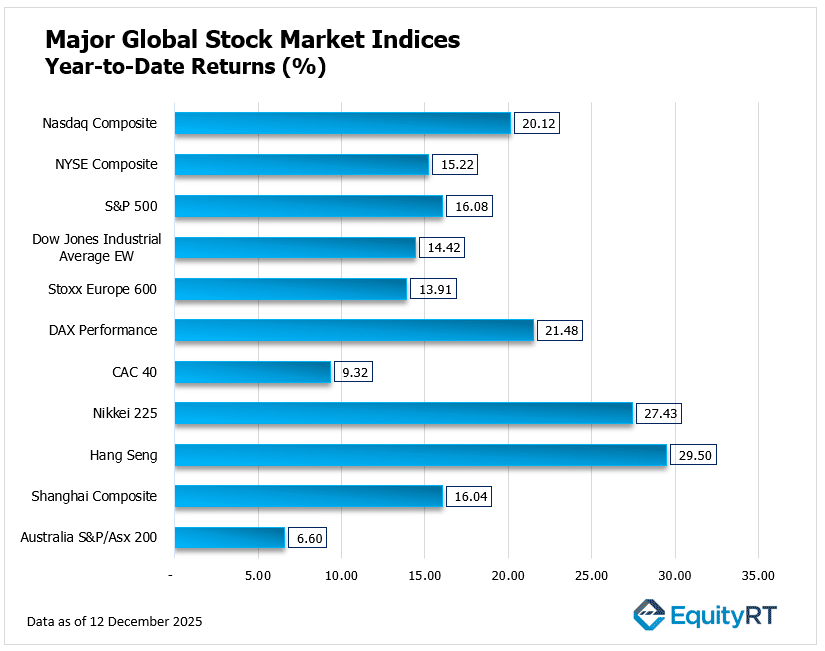
Year-to-Date (YTD) Performance Review of Global Stock Indices
The year-to-date performance of major global stock indices shows a clear divergence across regions. Japan and Hong Kong continue to lead global equity markets, with the Nikkei 225 up 27.43% and the Hang Seng rising 29.50% year-to-date. The strong performance of the Nikkei reflects sustained momentum in Japan’s corporate reforms and investor appetite for Japanese equities, while the Hang Seng’s sharp rebound suggests selective recovery in oversold China-related sectors, despite ongoing structural pressures.
In the U.S., equity markets have also delivered strong returns. The Nasdaq Composite has gained 20.12%, supported by large-cap technology stocks, while the S&P 500 is up 16.08%. The Dow Jones Industrial Average (equal-weighted) stands at 14.42%, indicating that performance breadth has remained relatively healthy across sectors. The NYSE Composite’s 15.22% gain reinforces the broader strength across U.S. markets.
European indices have posted more moderate gains. Germany’s DAX is up 21.48%, making it one of Europe’s strongest performers, while the Stoxx Europe 600 and CAC 40 have risen 13.91% and 9.32%, respectively. These returns point to steady but slower momentum in European equities compared to the U.S. and Asia, amid mixed economic data and uneven corporate earnings.
In the Asia-Pacific region outside Japan, performance has been softer. The Shanghai Composite is up 16.04%, largely tracking selective sectoral recoveries, while Australia’s ASX 200 has gained just 6.60%, reflecting pressure from commodity-linked sectors and a slower domestic growth outlook.
As markets enter the final weeks of the year, performance leadership remains concentrated in technology-heavy U.S. indices and Japan’s surging market, while other regions show a more uneven path toward recovery.
Market Summary: Dollar, Gold, Oil & U.S. Yields Update
The broader macro landscape shows clear divergences across major market indicators, reflecting shifting expectations around growth, inflation, and monetary policy. The US Dollar Index (DXY) held relatively steady, edging up 0.02% on the day but remaining down 9.28% year-to-date, signalling a weaker dollar environment driven by changing Federal Reserve expectations and capital flowing toward higher-beta assets.
In commodities, Brent crude oil extended its softer trend, closing at $61.12 per barrel and posting a notable 18.11% decline year-to-date. Weak demand signals, rising inventories, and concerns over global growth have weighed on energy markets, keeping prices under pressure.
Precious metals tell a very different story. Gold continued its strong upward momentum, rising 63.77% year-to-date, supported by safe-haven flows, declining real yields, and a softer dollar. Silver outperformed even further, surging 114.71% since the start of the year, reflecting both safe-haven demand and cyclical support from industrial use.
U.S. Treasury yields show a significant downward adjustment over the year, particularly at the short end. The 2-year yield fell 71.90 bps year-to-date, while the 10-year yield declined 39.20 bps, pointing to easing inflation pressures and solidifying expectations that the Federal Reserve will move further into a rate-cutting cycle in the months ahead. The drop in yields has been a key driver of the strong performance in risk assets and precious metals throughout 2025.

Summary of Major FX Rates vs. USD
Major global currencies continued to show a broadly firmer tone against the U.S. dollar reflecting a combination of softer U.S. dollar dynamics and improving sentiment in foreign exchange markets.
The euro appreciated to 1.17 USD, gaining 1.32% over the past month and 11.73% year-on-year, supported by stabilizing economic conditions in the euro area and shifting expectations around relative monetary policy paths. The British pound also strengthened moderately, with a 1.81% monthly gain and nearly 5% appreciation over the year, indicating steady investor confidence despite a mixed UK macro backdrop.
In the Asia-Pacific region, performance was more uneven. The Japanese yen remains weak on a yearly basis, down 2.14%, despite a modest rebound in recent sessions. By contrast, the Australian dollar continued its upward trajectory, rising 2.02% over the month and 4.35% over the year, benefiting from improved risk appetite and selective strength in commodity-linked assets.
Among Asian currencies more closely tied to China, the Chinese yuan appreciated modestly, gaining 0.88% over the month and 2.90% over the year, consistent with policy stabilization efforts and a gradual improvement in sentiment surrounding China’s outlook.


Take the Guesswork out of Investing: Backtest Your Strategies with Ease!
Weekly Economic Outlook
United States: A Data-Heavy Week Ahead
A dense U.S. data calendar will dominate market attention, led by the delayed jobs report, November CPI, and retail sales. The Labor Department will release non-farm payrolls for both October and November; however, only November will include an unemployment rate, as October figures were not collected during the government funding lapse and will not be reconstructed. Consensus expectations call for a 35K increase in November payrolls, supported by a 40K rise in private-sector jobs, while the jobless rate is expected to hold at 4.4%.
Inflation will be another focal point. November headline and core CPI are both projected at 3.2%, remaining above the Fed’s 2% target. October retail sales are forecast to rise 0.2%, matching September’s pace, the slowest since May.
Additional U.S. data releases include December flash S&P Global PMIs, the NY Empire State and Philadelphia Fed manufacturing indices, the NAHB Housing Market Index, November existing home sales, October capital flows, and the delayed September business-inventories report.
Markets will also parse comments from multiple Federal Reserve officials for policy guidance into 2026, along with earnings reports from Micron Technology, Accenture, FedEx, and Nike.
In Mexico, the central bank will deliver its monetary policy decision on Thursday. Canada faces a similarly busy week, featuring inflation, retail sales, housing starts, and new home price data.
Central Banks in Focus in Europe
Monetary-policy announcements will be at the center of attention in Europe as both the European Central Bank (ECB) and the Bank of England (BoE) hold meetings on Thursday.
For the ECB, the macro backdrop has remained largely unchanged since October: growth is soft but stable, and inflation continues to ease along the expected path. As a result, policymakers are widely expected to keep interest rates unchanged. Market focus will shift to updated ECB staff projections, particularly after some economists suggested that the next major move could be a rate hike rather than a cut, given the region’s firmer-than-expected economic resilience.
In contrast, the Bank of England is expected to cut rates by 25 basis points to 3.75%. U.K. inflation fell to 3.6% in October and is projected to ease further to around 3.5% in November. Although inflation remains above target, cooling price pressures and weakening domestic demand are seen as sufficient to push a previously divided MPC toward another rate reduction.
Elsewhere in Europe, Sweden, Norway, Hungary, and the Czech Republic are all expected to hold rates steady, while Russia is forecast to implement a fifth consecutive rate cut.
On the data front, flash PMIs will be released across major European economies. The Euro Area’s services sector is expected to register its strongest expansion since May 2023, while manufacturing activity is expected to stabilize.
German sentiment indicators are projected to improve, with the ZEW survey rising to a five-month high and the Ifo index to a four-month high.
The U.K. will publish unemployment, inflation, and retail sales data. The jobless rate is forecast to rise to 5.1%, the highest since early 2021, with wage growth slowing to its weakest pace in more than a year. Additional releases include Euro Area consumer sentiment, and trade balance; Germany’s producer prices; the U.K.’s CBI industrial trends and distributive trades surveys.
Asia: Data Releases and Key Policy Decisions
Weaker-than-expected economic activity indicators from China for November pointed to persistent economic fragility. Industrial production slowed to 4.8% year-on-year in November (vs. expectation: 5.0%), marking the slowest increase since August 2024. Fixed Asset Investment fell by 2.6% year-on-year in November (vs. expectation: 2.3% drop), following a 1.7% drop in October.
In Japan, attention will center on the upcoming Bank of Japan meeting, where policymakers are expected to raise the policy rate from 0.5% to 0.75%. Key data will include trade figures, inflation, machinery orders, and December flash PMIs.
In Australia, markets will examine the Westpac consumer confidence index and December flash PMIs.
Across the region, trade data from Singapore, Malaysia, and New Zealand will be in focus. Several central banks in Thailand, Indonesia, Taiwan, and Pakistan will also issue policy decisions. In addition, New Zealand will publish its Q3 GDP report.
Take the Guesswork out of Investing: Backtest Your Strategies with Ease!
Important Disclaimer
The information provided in this publication is for informational purposes only and is not, and should not be construed as, investment advice, financial advice, trading advice, or any other form of advice. You should not treat any information in this report as a specific solicitation to engage in any investment or financial activity. EquityRT is not responsible for any loss arising from any investment based on any material provided. Please consult with a qualified financial professional before making any investment decisions.