

Market Focus: Trump-Xi Talks and Global PMIs Take Center Stage After Fed Hike
Global markets enter the final full week of September with US-China relations, the global growth outlook and Middle East risks moving to the forefront following a major week for central banks.
The Federal Reserve raised its policy rate by 25 basis points to 3.75%-4.00%, its first increase in more than three years, and signaled that additional tightening may be required to bring inflation down more quickly. The decision has shifted the market debate from whether the Fed would hike to how far the renewed tightening cycle could extend, leaving incoming economic data and Fed communication particularly important.
At the same time, geopolitical and trade developments will command attention. US President Donald Trump and Chinese President Xi Jinping are expected to meet, with trade, AI, critical minerals and the Middle East among the major issues surrounding the talks. Preparatory discussions between US Treasury Secretary Scott Bessent and Chinese Vice Premier He Lifeng have already focused on AI, tariffs and rare-earth supplies.
Global flash PMIs will provide an important early indication of September economic activity across the US, Euro Area, UK, Japan, Australia and India. Meanwhile, monetary-policy decisions in Switzerland, Sweden, Norway, Mexico and Indonesia will keep global interest-rate policy firmly in focus.
US: Attention Shifts to Growth and Fed Guidance After the Hike
Following last week's rate increase, investors will closely monitor appearances by Fed officials for clues on the pace and extent of further tightening. Chair Kevin Warsh emphasized price stability following the decision, while the Fed indicated that additional increases in borrowing costs could be necessary in the coming months.
The economic calendar shifts toward activity indicators. August durable goods orders are expected to decline 0.5% after rising 1.1% in July, while new home sales are forecast to remain broadly unchanged. Flash S&P Global PMIs will provide an early assessment of September business conditions, with services expected to remain the main contributor to private-sector growth.
The data will be particularly important following the Fed's hawkish shift. With the 10-year Treasury yield hovering near the psychologically important 5% level, signs of resilient activity or renewed price pressures could reinforce expectations that interest rates will remain elevated.
US-China relations will provide an additional market catalyst. The Trump-Xi talks are expected to cover trade, critical minerals and AI, with technology restrictions and competition over advanced AI remaining important points of tension between the two countries.
Europe: PMIs Test the Growth Outlook as Central Banks Remain in Focus
Flash PMI data will dominate the European economic calendar, providing a timely assessment of activity across the Euro Area, Germany, France and the UK.
Manufacturing activity is expected to remain in expansion, with further improvement anticipated in the Euro Area, Germany and the UK, while France is expected to show softer momentum. Services activity is also expected to strengthen modestly across the Euro Area, although conditions remain uneven between individual economies.
In Germany, the Ifo Business Climate Index is expected to improve for a fifth consecutive month, potentially reaching its highest level since April 2024. Consumer indicators may provide a more cautious signal, however, as elevated energy costs and continued Middle East uncertainty weigh on household sentiment.
Monetary-policy decisions from the Swiss National Bank, Sweden's Riksbank and Norges Bank will add another dimension to the week. Their guidance will be watched for evidence of how renewed global inflation pressures and the Fed's return to tightening are influencing policy outside the US.
Asia-Pacific: China Policy, Japan PMIs and Australian Labor Data
China remains at the center of the Asian outlook, with monetary policy and US-China relations both in focus. The People's Bank of China has kept its one- and five-year Loan Prime Rates unchanged at 3.00% and 3.50%, respectively, for a 16th consecutive month, reflecting policymakers' preference for targeted support over broad monetary easing.
The Trump-Xi meeting will be particularly important for the region. AI technology, tariffs and critical-mineral supply chains are among the issues expected to feature prominently, with any indication of easing or renewed escalation in trade tensions potentially affecting technology and export-sensitive Asian markets.
Japan's markets will be disrupted by the Silver Week holidays, although preliminary September PMIs will provide an early reading on business activity. In Australia, attention turns to the labor market, with unemployment expected to remain at 4.5% and employment forecast to increase by 20,000.
India will release infrastructure output and preliminary PMIs, while inflation and trade data from several other Asian economies will provide additional evidence on regional price and demand conditions. Bank Indonesia's policy decision will also be closely watched amid broader concerns over emerging-market rates and capital flows.
What Investors Should Watch
1. What Comes After the Fed's September Hike?
The Fed has delivered the 25-basis-point increase markets were anticipating and signaled that further tightening may follow. Fed communication, US PMIs and durable goods orders will now help shape expectations for the next move.
2. Can Trump-Xi Talks Reduce US-China Trade and Technology Risks?
Trade, AI and critical minerals are emerging as key issues surrounding the meeting. Markets will be watching for signs of stabilization in bilateral relations—or renewed tension over technology and strategic supply chains.
3. Can Global Growth Withstand Higher Rates and Energy Costs?
Flash PMIs across several major economies will provide one of the first broad readings of September activity. With major central banks confronting renewed inflation pressures and Middle East tensions keeping energy risks elevated, the balance between growth resilience and inflation persistence is becoming increasingly important.
Global Equities: Tech Resilience Offsets Fed and Yield Pressure
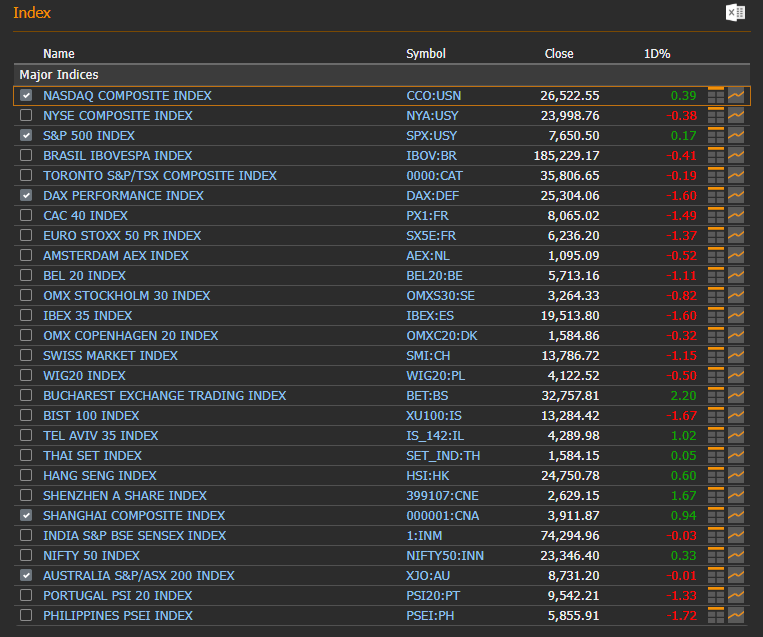
Global equities navigated a volatile week as major central banks stepped up their inflation fight, while elevated oil prices and government bond yields continued to challenge risk appetite. The Federal Reserve delivered its first rate increase in more than three years, raising the target range by 25 basis points to 3.75%–4.00%, while signaling that further tightening may be needed.
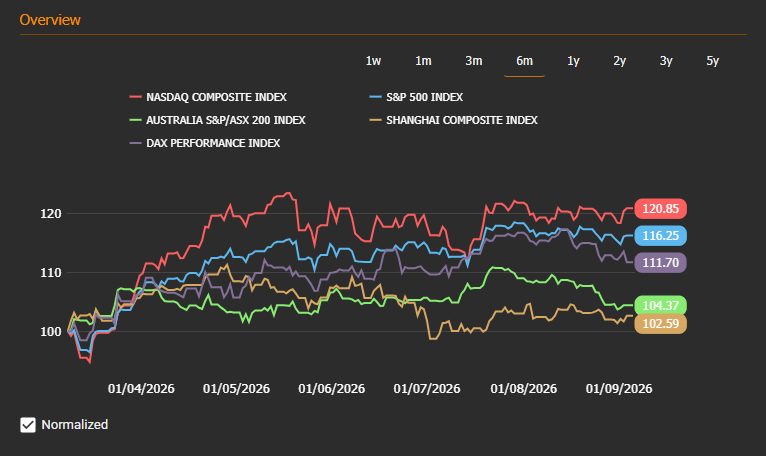
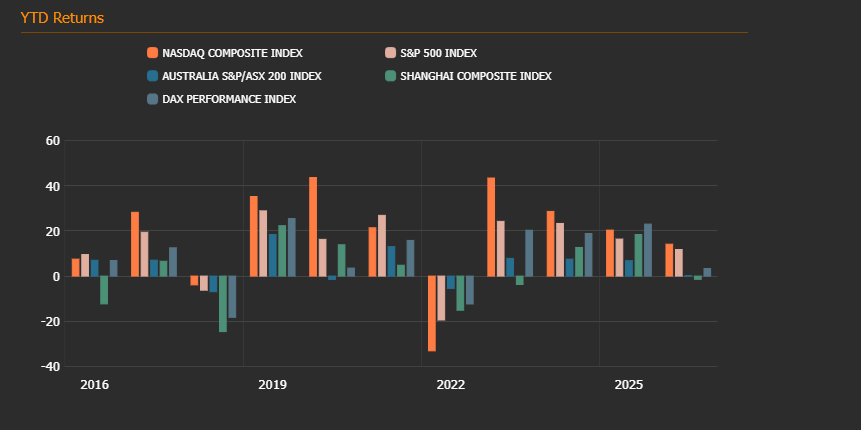
US equities proved relatively resilient despite the more hawkish monetary-policy backdrop. The S&P 500 finished the week nearly unchanged, while the Nasdaq recorded a weekly gain, supported by strength in semiconductor and technology shares. The Dow underperformed, posting its largest weekly percentage decline since March. Markets were particularly volatile around the Fed decision, with the S&P 500 falling 0.44% on Wednesday before equities rebounded strongly on Thursday as oil prices and Treasury yields eased.
Technology remained an important source of support, but the AI theme faced renewed scrutiny. Semiconductor stocks were hit early in the week after prominent AI executives called for a slowdown in AI development over safety concerns, contributing to Monday's equity decline. Chip stocks subsequently recovered, helping the Nasdaq outperform by the end of the week.
European equities were weaker, with the STOXX 600 falling 1.1% on Friday and ending the week 0.6% lower. The index had recovered following the Fed decision as oil and bond yields eased, but Friday's broad selloff erased those gains. Autos were particularly weak after Volkswagen cut its outlook, while telecommunications also came under significant pressure.
Source: EquityRT Markets Overview. Data as of 18/09/2026
Commodity Markets: Oil Holds Above $100 as Precious Metals Rebound
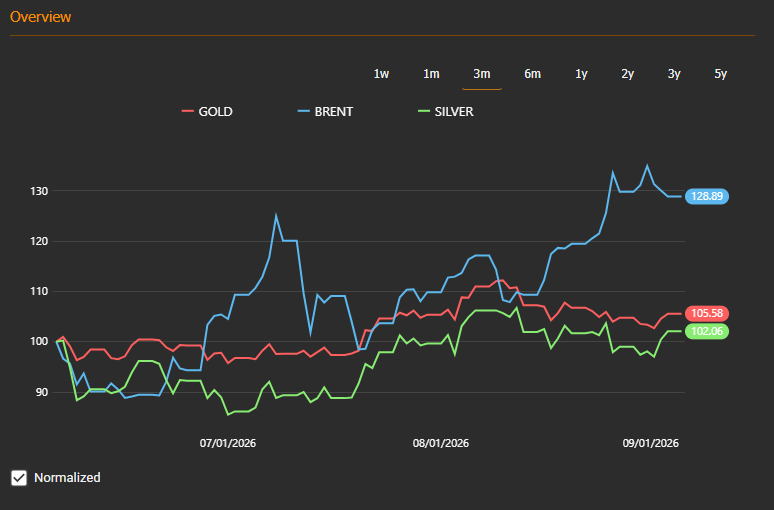
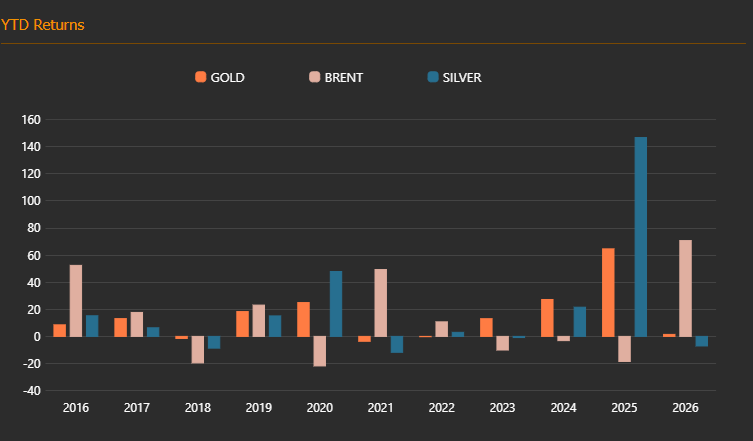
Commodity markets remained heavily influenced by Middle East supply risks and shifting expectations for global monetary policy. Oil stayed above $100 per barrel as disruptions to regional energy flows kept supply concerns elevated, although prices eased toward the end of the week as fears of further Saudi supply disruptions moderated. Precious metals, meanwhile, recovered as softer oil prices provided some relief from inflation concerns.
Brent crude settled at $104.87 per barrel on Friday, down 0.9% on the session. Prices had climbed earlier in the week as attacks involving Saudi Arabia and Yemen's Iran-aligned Houthis heightened concerns over energy infrastructure and alternative export routes. Later reports that additional Saudi crude could reach international markets, together with China's efforts to encourage Iran to limit Houthi attacks on Saudi facilities, helped ease some of those concerns.
Gold reversed part of its recent weakness and recorded its first weekly gain in four weeks. Bullion initially came under pressure after the Federal Reserve raised its policy rate to 3.75%-4.00% and signaled that further increases could follow, falling more than 1% immediately after Wednesday's decision. However, easing oil prices subsequently reduced some inflation concerns and supported a recovery, with spot gold rising 1.2% on Friday to around $4,390 per ounce.
Silver also rebounded, rising 2.3% on Friday to $66.70 per ounce and heading for a weekly gain. The recovery across precious metals came despite a stronger dollar and elevated Treasury yields, highlighting the competing influences of tighter monetary policy, geopolitical uncertainty and changing energy-driven inflation expectations.
Source: EquityRT Commodity Overview. Data as of 18/09/2026
Yield Curve Watch: Fed Hike Flattens the Curve as Long-Term Yields Remain Elevated
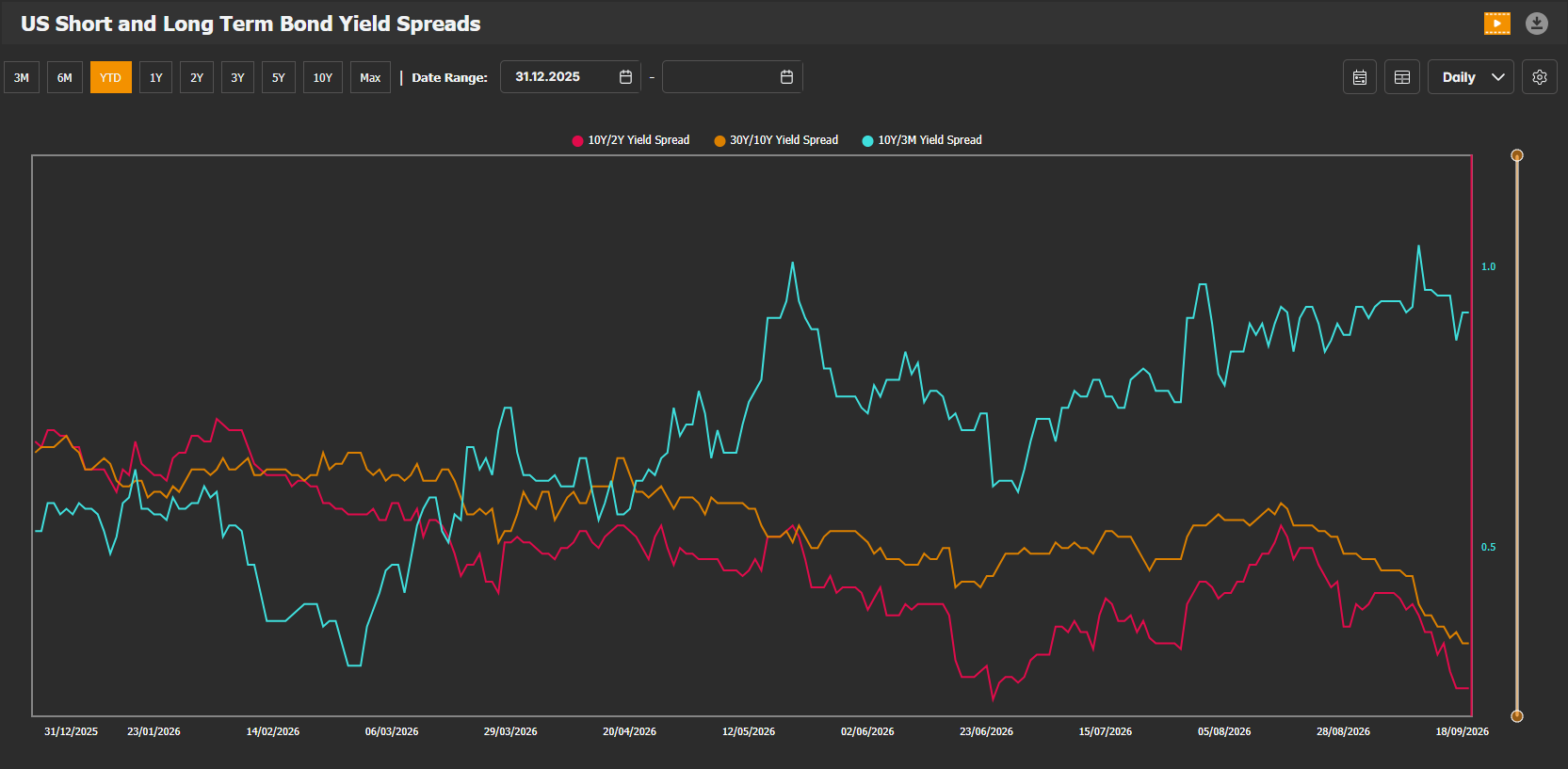
US Treasury yields remained elevated during a volatile week as the Federal Reserve delivered its first rate increase in more than three years and signaled that further tightening could follow. The Fed raised its target range by 25 basis points to 3.75%-4.00%, while Chair Kevin Warsh maintained a firm stance on inflation. The 10-year Treasury yield briefly moved above 5% during the week before retreating as oil prices eased and some inflation concerns moderated.
The 10Y-2Y spread narrowed further during the week, falling toward roughly 0.2 percentage points. This is consistent with stronger upward pressure on the policy-sensitive front end of the curve following the Fed hike and its relatively hawkish guidance. The move represents a marked flattening from mid-August, when the spread had temporarily widened toward 0.5 percentage points.
The 10Y-3M spread remains much wider, at around 0.9 percentage points, despite some volatility around the Fed decision. This part of the curve continues to reflect the substantial gap between longer-term Treasury yields and three-month rates, with the long end supported by persistent inflation concerns, elevated energy prices and fiscal uncertainty.
The 30Y-10Y spread has also compressed sharply, falling toward roughly 0.3 percentage points. The narrowing suggests that the recent increase in yields has been concentrated more heavily in shorter and intermediate maturities rather than representing a straightforward long-end steepening. Nevertheless, absolute long-term borrowing costs remain historically high, with investors continuing to demand compensation for inflation, fiscal and Treasury-supply risks.
Source: EquityRT ChartPro, Data as of 18/09/2026
Gold vs DXY: Gold Rebounds Despite a Firmer Dollar After Fed Hike
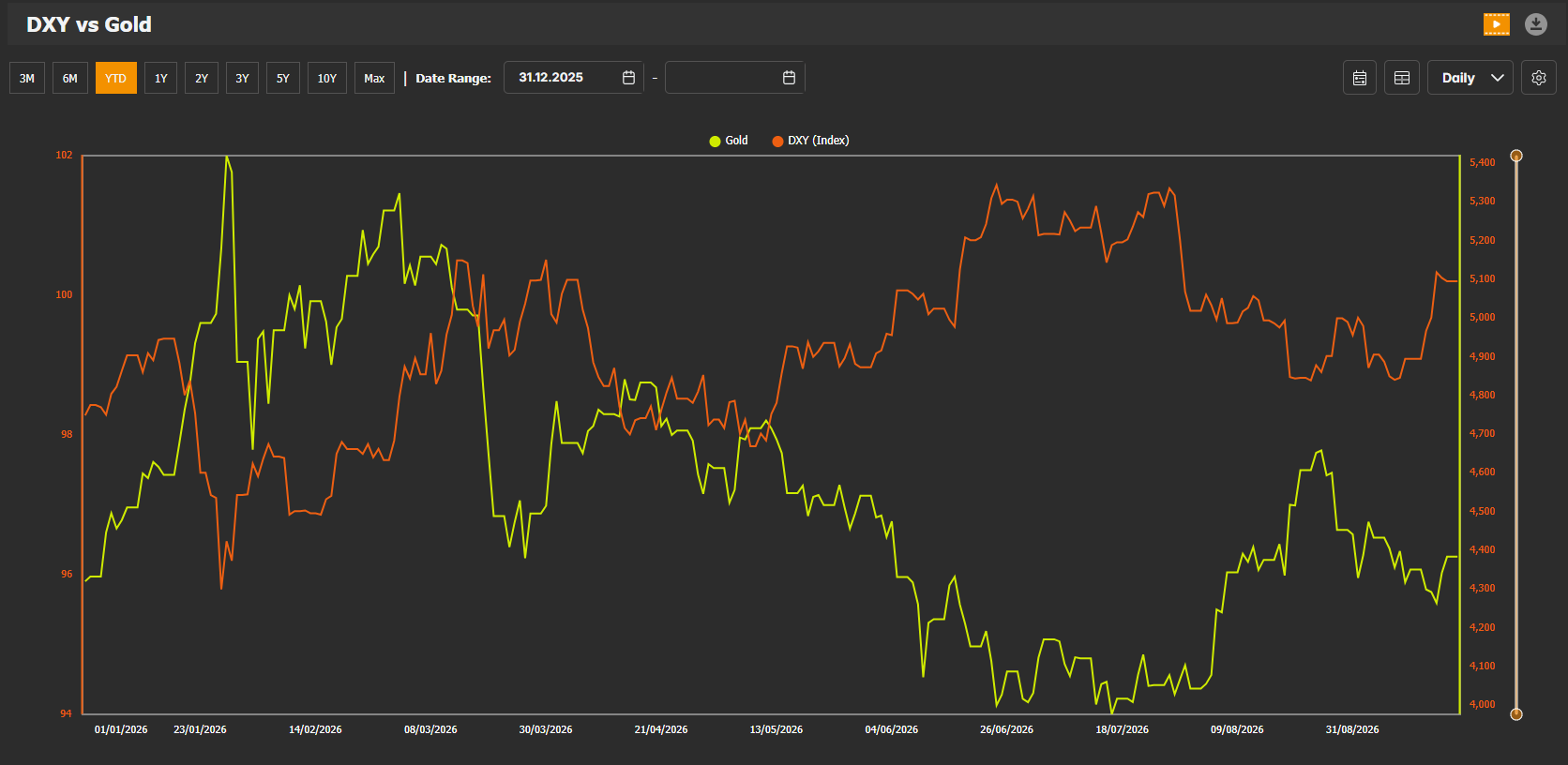
Gold recovered during the week despite a firmer US dollar, highlighting the competing forces currently shaping precious-metal markets. The Federal Reserve raised rates by 25 basis points to 3.75%-4.00% and signaled that further tightening could follow, initially pushing gold lower and supporting the dollar.
The dollar strengthened following the Fed decision as Chair Kevin Warsh maintained a relatively hawkish stance on inflation. Higher US yields and expectations that monetary policy could remain restrictive supported the DXY, which moved back above the 100 level late in the week.
Gold nevertheless recovered from its post-Fed decline and recorded its first weekly gain in four weeks. Spot gold rose around 1.2% on Friday to approximately $4,390 per ounce, helped by easing oil prices and continuing geopolitical uncertainty. The recovery came despite elevated Treasury yields and a stronger dollar, suggesting that safe-haven demand and shifting inflation expectations continued to provide underlying support.
With the September Fed decision now behind markets, the next test will be whether the dollar can sustain its recovery as investors assess the path for further rate increases. For gold, persistent geopolitical uncertainty could continue to provide support, while another rise in US yields would remain an important headwind.
Source: EquityRT ChartPro, Data as of 18/09/2026
📈 Chart of the Week: Can Markets Absorb a 5% Treasury Yield?
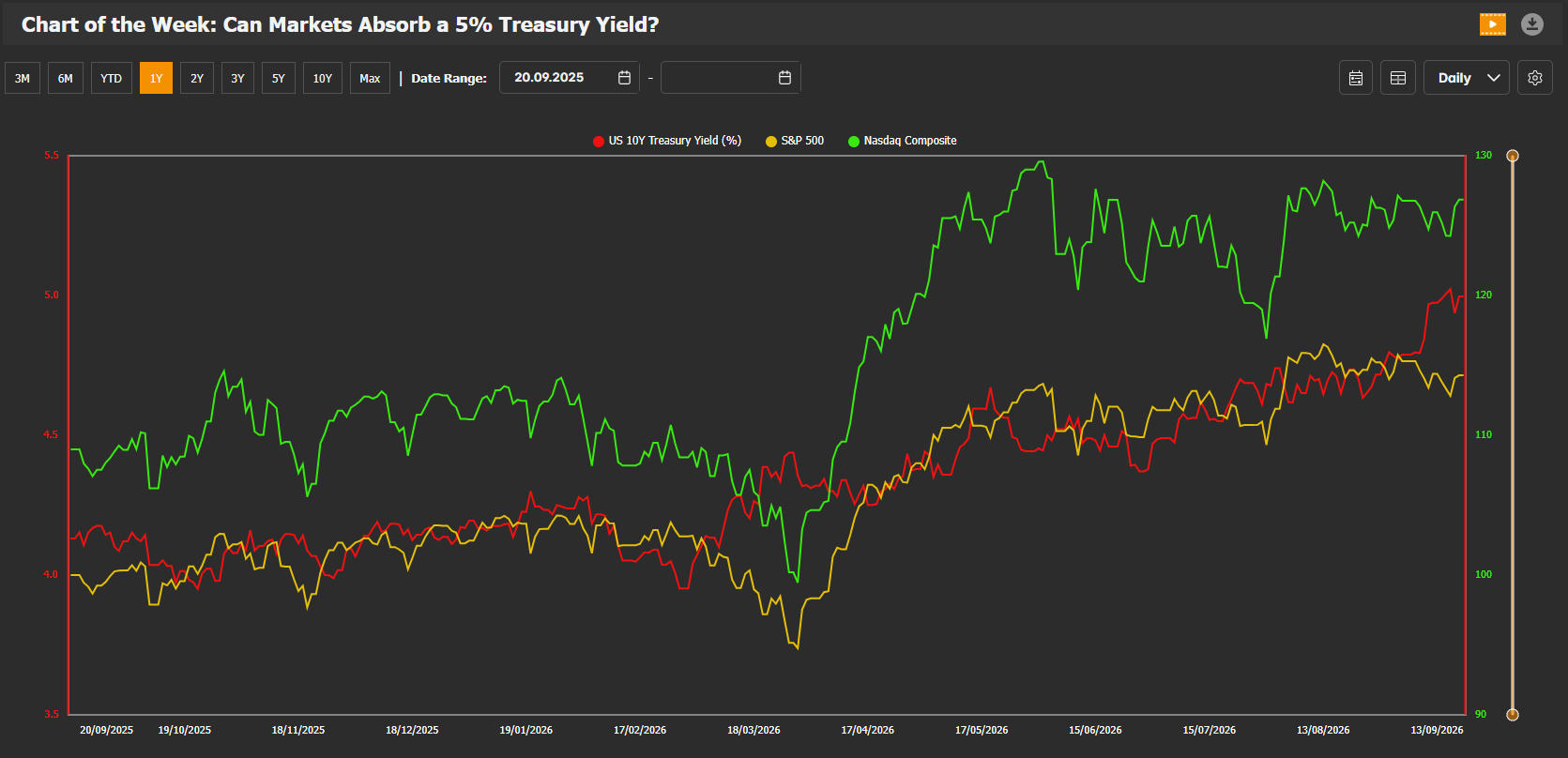
The US 10-year Treasury yield has climbed to around 5%, a level increasingly viewed as an important threshold for financial markets. Yet US equities have remained resilient, with the S&P 500 and particularly the Nasdaq still well above their levels a year ago.
Higher yields increase borrowing costs and make bonds more competitive with equities, creating a potential headwind for valuations. So far, however, resilient economic growth and corporate earnings have helped equities absorb the rise in rates.
With the Fed signaling that further tightening may follow, the key question is whether markets can remain resilient if Treasury yields stay around or move decisively above the 5% level.
Source: EquityRT | Data 18/09/2026