

Market Focus: US Inflation, Q3 Earnings and Global Growth Take Center Stage
Global markets enter the week of October 12-16 with US inflation data, the start of the third-quarter earnings season and persistent pressure in global bond markets firmly in focus.
September CPI and PPI figures will provide fresh evidence on inflation ahead of the Federal Reserve’s next policy decision, while earnings from major US banks and technology companies will offer insight into corporate profitability and economic resilience.
The IMF and World Bank Annual Meetings in Bangkok will also attract attention, with the IMF’s updated World Economic Outlook and remarks from leading central bankers, including Fed Chair Kevin Warsh, providing an assessment of global growth, inflation and financial stability.
Elevated energy prices and government bond yields remain important risks for financial markets. Investors will continue monitoring negotiations involving Iran, the US and Gulf nations, as diplomatic progress could ease energy-market pressures, while renewed military escalation could reinforce inflation concerns and keep borrowing costs elevated.
Elsewhere, Eurozone industrial production and inflation data, China's trade and credit figures, and labor-market reports from Australia and India will help assess the resilience of global economic activity. Corporate earnings from TSMC, ASML and LVMH will provide additional signals on semiconductor demand, AI investment and consumer spending.
US: Inflation Data and Bank Earnings Test Market Expectations
September consumer inflation will be the main US economic event, providing a critical update on price pressures ahead of the Federal Reserve's next policy decision.
Headline CPI is expected to increase by 0.6% month-on-month, largely reflecting higher fuel costs, while core inflation is forecast to rise by 0.2%. On an annual basis, headline inflation is projected to accelerate to 3.6% from 3.4%, with core inflation edging up to 2.5% from 2.4%.
Producer prices will also be closely watched, with headline PPI expected to increase by 0.5% month-on-month and core PPI by 0.3%. Together, the releases will help determine whether elevated energy costs are translating into broader inflation pressures and potentially complicating the Fed's interest-rate outlook.
Consumer spending and industrial activity will provide additional evidence on US economic resilience. September retail sales are forecast to increase by 0.3%, following a 1.2% gain in August, while industrial production is expected to rebound by 0.3%. Existing home sales are projected to ease slightly to 3.97 million.
Other releases include import and export prices, business inventories, the federal budget balance, Treasury International Capital flows, and regional manufacturing surveys from the New York and Philadelphia Federal Reserve Banks.
The third-quarter earnings season will also move into focus, with JPMorgan Chase, Citigroup, Goldman Sachs, Wells Fargo, Bank of America and Morgan Stanley reporting results. Investors will assess lending activity, credit quality, investment-banking revenues and management outlooks for signs of how higher interest rates are affecting the financial sector. Results from Johnson & Johnson, UnitedHealth and BlackRock will provide further insight into corporate performance.
Elsewhere in the Americas, investors will monitor Canadian housing starts, Mexican industrial production, Brazilian retail sales and business confidence, and Argentine inflation.
Europe: Inflation and Industrial Activity in Focus
The European economic calendar is relatively light, with final Eurozone inflation figures, industrial production and trade data providing the main economic signals.
September Eurozone inflation is expected to be confirmed at 3.8% year-on-year, keeping price pressures firmly in focus as investors assess the outlook for further ECB tightening. Industrial production is forecast to recover modestly by 0.1%, while trade figures will provide additional evidence on external demand.
Germany will release final inflation and wholesale price data, with wholesale prices expected to rise by 0.7% month-on-month. Final consumer inflation readings are also due from France, Italy and Spain.
In the UK, August GDP is expected to contract by 0.1%, while industrial production is also forecast to decline by 0.1%. A wider goods trade deficit would add to concerns about the strength of domestic activity.
Corporate earnings will be particularly important for European markets. ASML's results will offer insight into semiconductor equipment demand and the global AI investment cycle, while LVMH's performance will provide a read on luxury consumption and demand from major international markets.
Asia-Pacific: China Trade, Inflation and TSMC Earnings Lead the Calendar
China's September trade and inflation figures will be closely watched for signs of domestic demand, external trade resilience and the effects of international protectionist measures.
Annual consumer inflation is expected to accelerate to 1.1% from 0.8%, partly reflecting higher energy prices, while producer price inflation is forecast at 4.4%.
Exports and imports are projected to increase by 25.3% and 23.5%, respectively. New yuan loans, expected at CNY 975 billion, will provide additional evidence on credit conditions and financing activity.
In Japan, September producer price inflation is expected to remain at 7.6%, while August machinery orders are forecast to rebound by 2.5% month-on-month. Bank lending figures will also be monitored for indications of domestic financing conditions.
Australia's September employment report will be a key regional release. The unemployment rate is expected to remain at 4.6%, with employment growth forecast at 20,000. Minutes from the Reserve Bank of Australia's September meeting, when it raised its cash rate to 4.6%, will provide further insight into the policy outlook.
India will publish consumer and wholesale inflation, trade and unemployment data. Singapore and Malaysia are scheduled to release GDP figures, while South Korea will report labor-market data.
TSMC's third-quarter earnings will be a major focus for global technology investors, offering fresh evidence on demand for advanced semiconductors, AI infrastructure and the sustainability of the technology investment cycle.
What Investors Should Watch
1. Will US Inflation Complicate the Fed's Next Decision?
September headline CPI is expected to accelerate to 3.6% annually, with higher energy prices contributing to the increase. CPI and PPI readings will be critical for assessing whether inflation pressures could reinforce expectations for further monetary tightening despite recent signs of softer labor-market conditions.
2. Can Corporate Earnings Justify Equity Valuations?
Third-quarter results from major US banks, TSMC, ASML and other corporate leaders will test the resilience of earnings expectations. Investors will focus on financial-sector credit conditions, corporate spending and AI-related demand, particularly as elevated Treasury yields continue to challenge equity valuations.
3. Can Global Growth Withstand Higher Rates and Energy Costs?
The IMF's updated World Economic Outlook, US retail sales and industrial production, Eurozone activity data and China's trade figures will provide a broader assessment of global growth. Resilient activity could support corporate earnings but may also sustain inflation and interest-rate pressures.
4. Will Middle East Diplomacy Ease Inflation and Bond-Market Risks?
Negotiations involving the US, Iran and Gulf nations remain an important market catalyst. Progress toward de-escalation could reduce energy supply risks and ease inflation expectations, while renewed military action could push oil prices and government bond yields higher.
Global Equities: Earnings Optimism Supports Stocks Despite Elevated Yields and AI Volatility
Global equities ended the week on a firmer note, supported by expectations for strong third-quarter corporate earnings and easing concerns over Middle East energy supply disruptions. However, elevated government bond yields, persistent inflation risks and renewed uncertainty surrounding AI-related valuations continued to influence investor sentiment.
US Treasury yields remained near multi-decade highs, with the benchmark 10-year yield ending Friday around 5.24%, following another volatile week in bond markets. Brent crude remained above $100 per barrel despite some easing in supply concerns after President Trump indicated that the US would refrain from attacking Iran ahead of November's midterm elections.
US equities finished Friday higher, with the S&P 500 advancing approximately 0.6% to 7,811.54, the Nasdaq Composite gaining 0.6% to 27,366.17, and the Dow Jones Industrial Average rising 0.8% to 51,654.95.
On a weekly basis, the S&P 500 gained approximately 1.2%, the Dow rose 0.9%, and the Nasdaq advanced 0.6%. The Russell 2000, however, declined 0.9%, highlighting uneven performance across market segments.
Technology stocks remained an important source of market support, although AI-related shares experienced heightened volatility. Concerns over the outlook for AI revenues weighed on semiconductor and infrastructure-related companies during the week, while software and large-cap technology shares showed greater resilience. Investors increasingly turned their attention to upcoming results from TSMC and ASML for further evidence of the strength of AI investment demand.
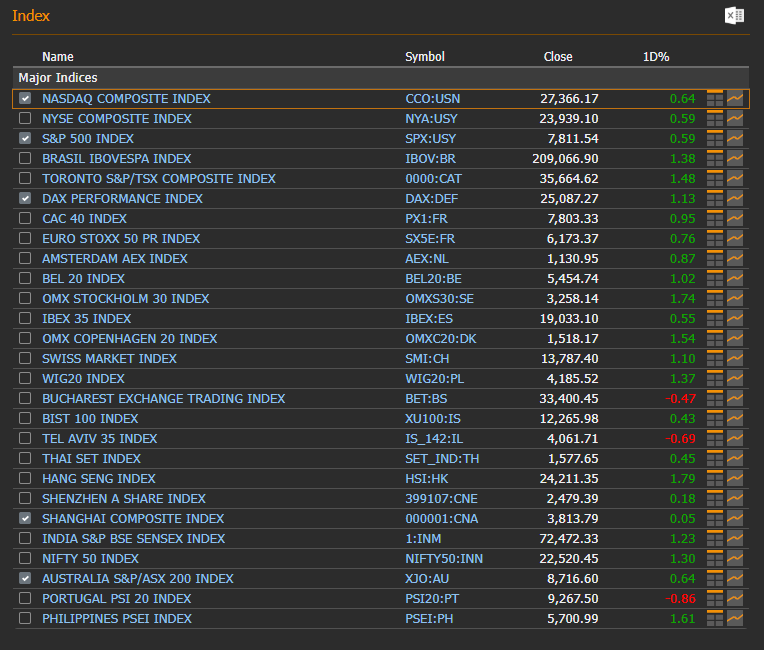
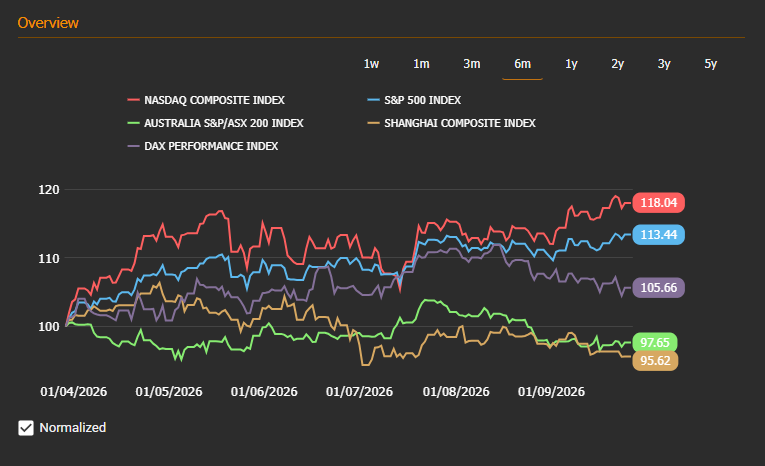
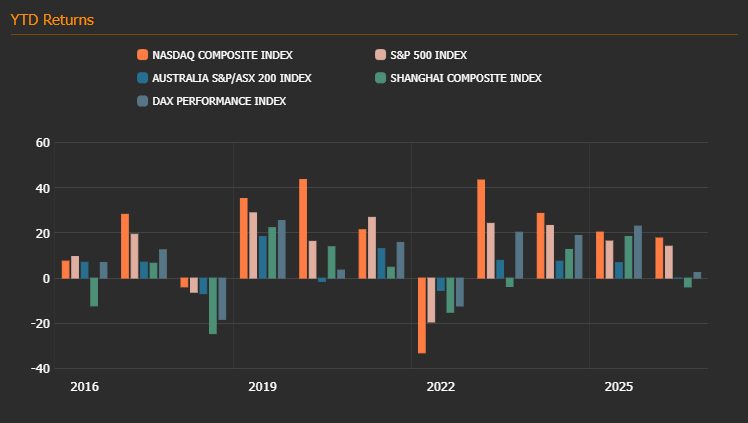
Source: EquityRT Markets Overview. Data as of 09/10/2026
Commodity Markets: Brent Holds Above $100 as Gold and Silver Recover
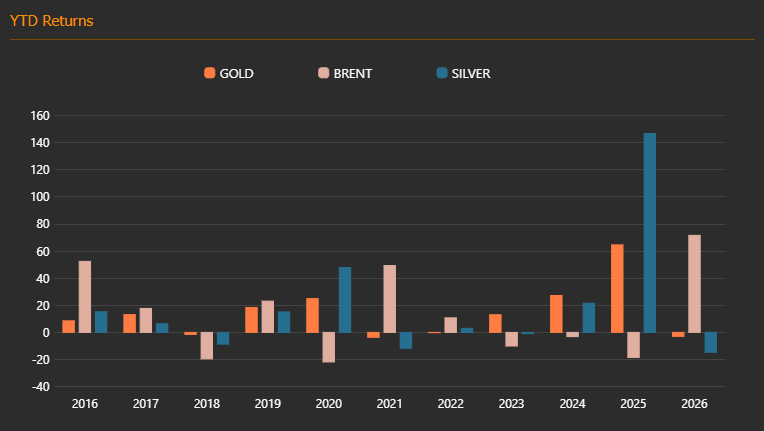
Energy markets remained sensitive to Middle East developments during the week ending October 9, 2026, with Brent crude holding above $100 per barrel amid persistent concerns over regional supply disruptions. Investors continued to monitor diplomatic developments involving the US and Iran, as any progress toward de-escalation could ease the geopolitical risk premium embedded in oil prices.
Precious metals rebounded on Friday despite elevated US Treasury yields and a strong dollar. According to EquityRT market data for October 9, gold rose 1.47% to $4,193.87 per troy ounce, while silver advanced 2.75% to $60.80 per troy ounce, outperforming gold on the day.
The gains suggest renewed buying interest in precious metals following their recent weakness. Nevertheless, persistently high bond yields remain a headwind for non-yielding assets, while geopolitical uncertainty continues to support demand for defensive investments.
Brent crude settled at $104.72 per barrel on Friday, up 0.42% on the day and approximately 2.4% for the week. Prices initially declined following reports of productive US-Iran negotiations but recovered as Hurricane Isaias forced shutdowns of more than 70% of offshore oil production in the US Gulf of Mexico. Ongoing disruptions to Middle Eastern shipping routes continued to underpin prices.
Gold and silver also recorded weekly gains, with independent closing-price data indicating advances of approximately 1.3% and 0.7%, respectively. Gold benefited from a softer US dollar and some easing in oil-driven inflation concerns, while silver's stronger Friday rebound highlighted its greater short-term volatility. Both metals remain sensitive to the Federal Reserve's policy outlook, particularly as elevated Treasury yields increase the opportunity cost of holding non-yielding assets
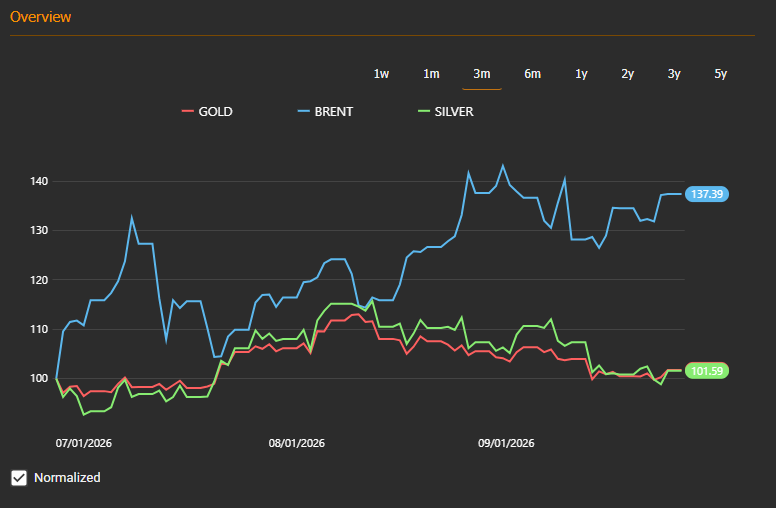
Source: EquityRT Commodity Overview. Data as of 09/10/2026
Yield Curve Watch: Short-to-Long Spreads Remain Elevated Despite Late-Week Narrowing
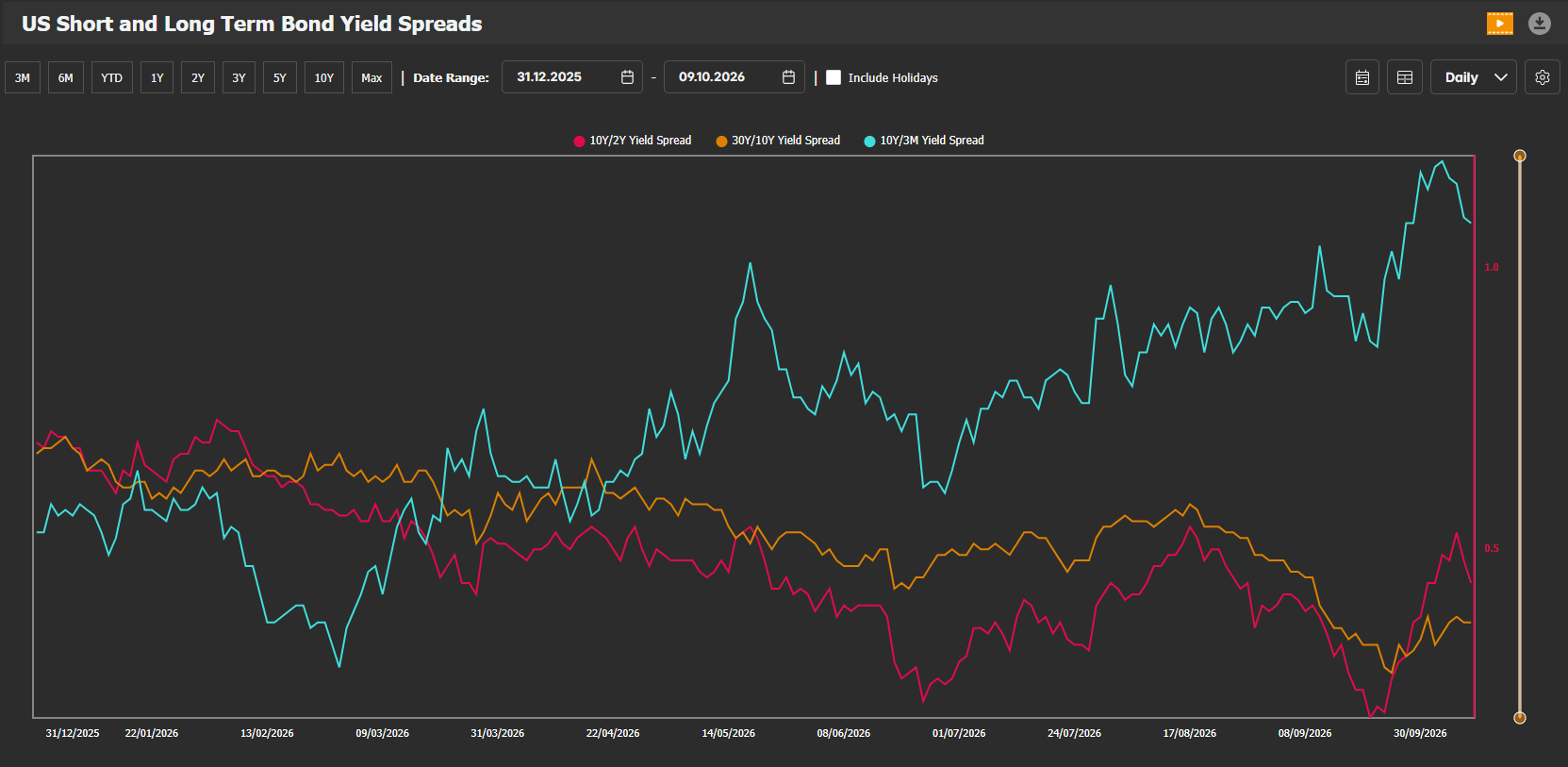
The US Treasury yield curve remained positively sloped during the week ending October 9, with elevated long-term borrowing costs continuing to reflect inflation concerns, energy-market uncertainty and expectations of restrictive monetary policy. Although Treasury yields eased from recent highs, the spread between longer-dated securities and short-term instruments remained substantial.
The 10Y-3M spread continued to show the most pronounced steepening, reaching approximately 1.2 percentage points in early October before narrowing to around 1.1 percentage points by Friday. Despite this pullback, the spread remained near its highest levels of the year, highlighting the persistent premium investors require to hold longer-maturity Treasuries relative to short-term bills.
The 10Y-2Y spread also recovered from its late-September lows, widening to approximately 0.5 percentage points before retreating toward 0.4 percentage points at the end of the week. The recovery suggests that longer-term inflation and term-premium pressures remain important drivers of the yield curve, even as expectations for additional near-term Federal Reserve tightening have moderated.
The 30Y-10Y spread remained comparatively narrow at around 0.3 percentage points, following a modest recovery from its September lows. This indicates that recent steepening has been concentrated primarily between short- and intermediate-to-long-term maturities rather than extending uniformly across the entire curve.
Source: EquityRT ChartPro, Data as of 09/10/2026
Gold vs DXY: Dollar Strength Persists as Gold Stages a Late-Week Recovery
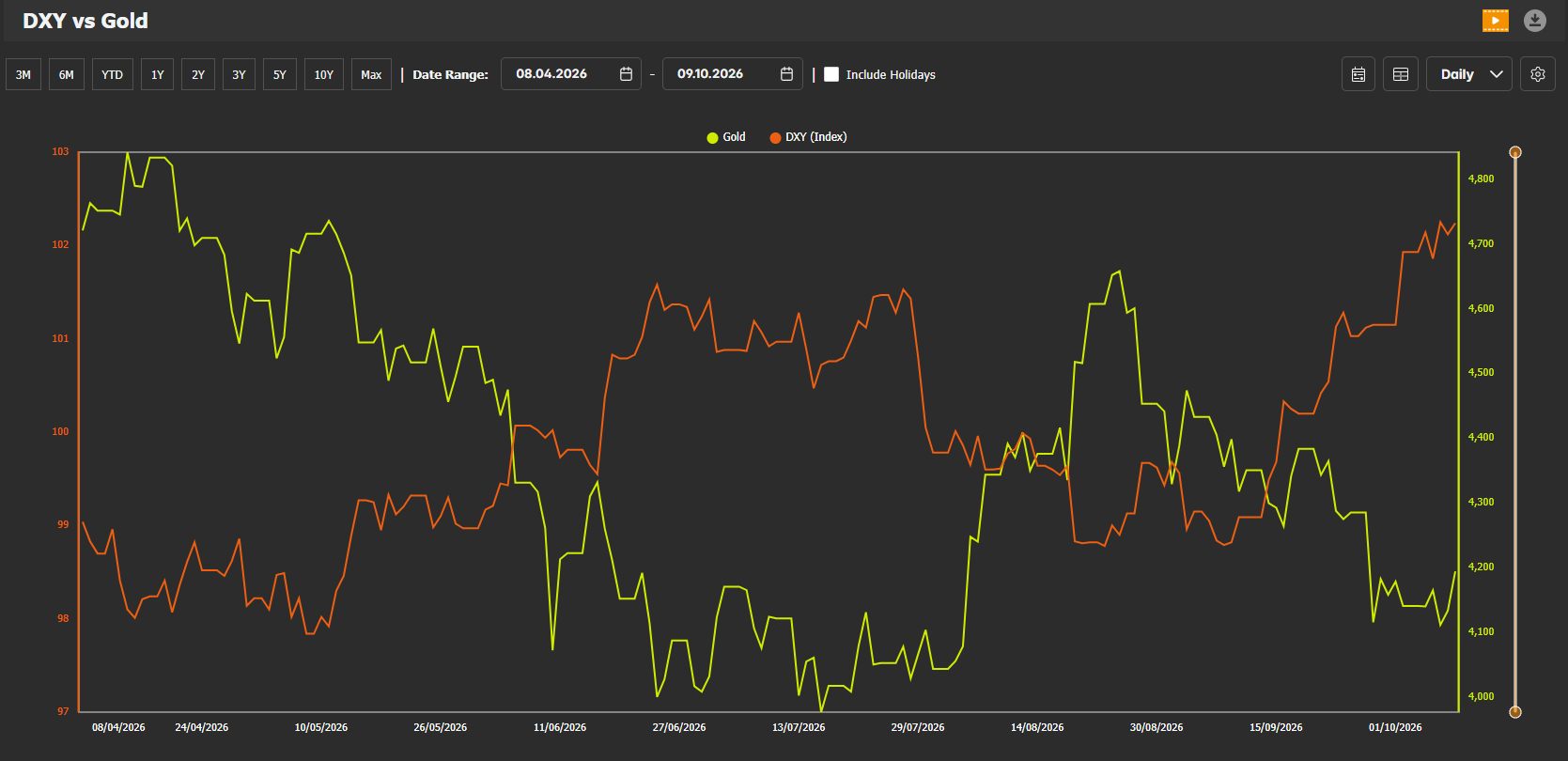
The US dollar strengthened further during the week ending October 9, while gold remained under pressure despite a rebound on Friday. Elevated Treasury yields, persistent inflation concerns and uncertainty surrounding the Federal Reserve's interest-rate outlook continued to support the dollar and weigh on non-yielding precious metals.
The US Dollar Index (DXY) climbed to approximately 102.2, extending its recovery from September lows near 98.8. The six-month chart shows a particularly pronounced appreciation since mid-September, reflecting renewed dollar strength as US borrowing costs remained elevated. The index finished the week near the upper end of its recent trading range.
Gold, meanwhile, recovered to $4,193.87 per ounce on Friday, gaining 1.47% on the day, according to EquityRT data. Nevertheless, bullion remained well below its late-August peak of approximately $4,650 and continued to face pressure from the stronger dollar and elevated US yields. The late-week rebound suggests some renewed buying interest following the sharp decline recorded since September.
The inverse relationship between gold and the dollar has become increasingly pronounced in recent weeks. While geopolitical uncertainty continues to provide potential support for safe-haven demand, the combination of dollar appreciation and high Treasury yields has constrained gold's recovery.
Source: EquityRT ChartPro, Data as of 09/10/2026
📈 Chart of the Week: Is Inflation Complicating the Fed’s Next Move?
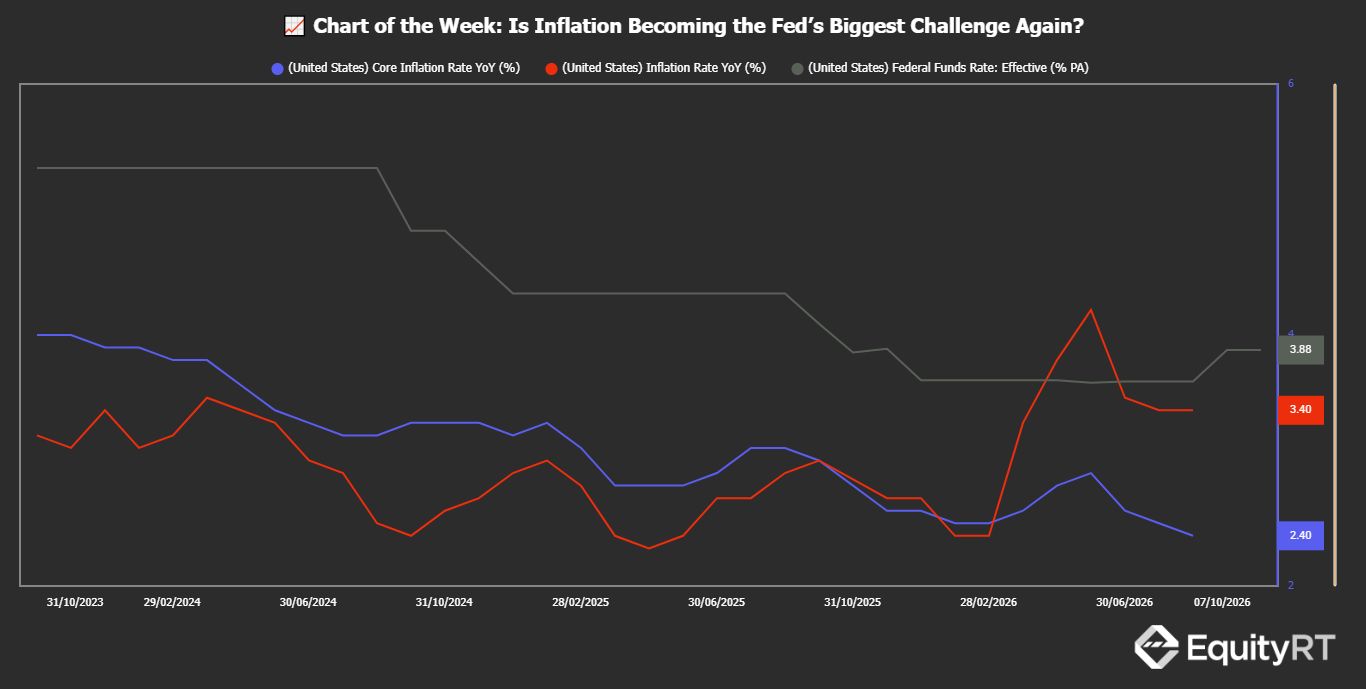
The US inflation outlook has become increasingly uneven, with headline consumer prices accelerating while underlying inflation continues to moderate. The latest available data show annual headline inflation at 3.4%, compared with core inflation at 2.4%, highlighting the growing influence of energy prices on overall inflation.
The divergence presents a challenge for the Federal Reserve. While softer core inflation and signs of labor-market weakness suggest that underlying price pressures are easing, renewed increases in headline inflation could complicate the case for pausing monetary tightening. The effective Federal Funds rate, at approximately 3.88%, remains above both inflation measures.
September's CPI report will therefore be a key test for markets. A stronger-than-expected reading could reinforce concerns about persistent inflation and keep Treasury yields elevated, while softer data could strengthen expectations for a Fed pause.
Source: EquityRT | Data as of 09/10/2026