

Market Focus: Central Bank Decisions, US Inflation and Big Tech Earnings Dominate
Global markets enter October 26-November 1 facing a week for monetary policy, growth and corporate earnings. The Federal Reserve, European Central Bank and Bank of Japan will announce interest-rate decisions, while preliminary third-quarter GDP estimates and US PCE inflation will test the resilience of growth against renewed price pressures.
In the United States, the Fed is widely expected to leave rates unchanged on October 28 following its September increase. Attention will focus on Chair Kevin Warsh’s guidance and the scope for a December move. The advance estimate of third-quarter GDP is expected to show annualized growth of around 3.0%, while September headline PCE prices are forecast to rise 0.5% month-on-month and core PCE by 0.3%.
Europe faces an ECB decision, the UK Autumn Budget, Euro Area GDP and preliminary inflation readings across major economies. In Asia-Pacific, the Bank of Japan’s policy meeting, Australian inflation and China’s policy deliberations will shape expectations for regional growth and interest rates.
Geopolitical risk remains central after renewed attacks on Saudi energy infrastructure drove Brent crude to its highest settlement in nearly six months. Elevated oil prices threaten to sustain inflation and complicate monetary policy even as Treasury yields have retreated from recent peaks.
Quarterly results from Microsoft, Alphabet and Amazon will test the outlook for AI investment and cloud spending. Earnings from major industrial, energy, healthcare and payments companies will provide a broader read on consumer demand, capital expenditure and profit margins.
U.S.: Fed Decision, PCE Inflation and Third-Quarter GDP in Focus
The Federal Reserve announces its October policy decision on Wednesday, October 28. A hold is widely expected after September’s increase, but investors will scrutinize the statement and Chair Warsh’s press conference for clues about the balance between persistent inflation and signs of softer employment.
September PCE inflation data will provide the next major test of the inflation outlook on Thursday. Headline prices are expected to rise 0.5% month-on-month, with core PCE increasing 0.3%. The release comes alongside the advance estimate of third-quarter GDP, forecast to show growth of around 3.0% annualized, up from 2.2% in the previous quarter.
Durable goods orders are forecast to rebound by 0.6%, while new home sales are expected to ease to approximately 660,000. Housing-price measures, consumer confidence, the goods trade balance, employment costs and regional manufacturing surveys will add detail on domestic demand and price pressures.
The timing of the Fed decision ahead of the PCE release makes forward guidance especially important. Investors will assess whether policymakers can justify holding rates steady while keeping the option of further tightening open if energy-driven inflation persists.
The earnings calendar is exceptionally busy, led by Microsoft, Alphabet and Amazon. Reports from Visa, Mastercard, Eli Lilly, ExxonMobil, Chevron, Coca-Cola, Caterpillar, Boeing and other major companies will test the strength of AI investment, consumer spending, credit demand and corporate margins.
Elsewhere in the Americas, the Bank of Canada announces its policy decision, while Canada releases monthly GDP. Mexico publishes third-quarter GDP and trade figures, Brazil holds a presidential runoff election and Chile also decides on interest rates.
Taken together, the policy decisions, growth data and earnings will show whether resilient activity can coexist with inflation that remains above central-bank targets.
Europe: ECB Decision, UK Budget and Euro Area Growth Take Center Stage
The European Central Bank announces its rate decision on Thursday, with economists broadly expecting no change after earlier tightening. Investors will examine President Christine Lagarde’s assessment of inflation, energy costs and the possibility of another increase later in the year.
The Euro Area’s preliminary third-quarter GDP estimate is expected to show growth slowing to 0.2% quarter-on-quarter from 0.6%, with annual growth around 1.1%. Spain is forecast to outperform major peers, while Germany and Italy are expected to post only modest quarterly expansions.
The UK Autumn Budget on Wednesday will be closely watched for measures addressing higher energy costs while preserving fiscal credibility. The balance between household support, taxation and borrowing could influence sterling, gilt yields and the domestic growth outlook.
Preliminary inflation figures from Germany, France, Spain and Italy, together with German Ifo business confidence and labor-market releases across the region, will offer fresh evidence on price pressures and activity. UK housing and retail indicators and Swiss economic releases also feature.
Corporate results from HSBC, Santander, Novartis, TotalEnergies and other European companies will add insight into banking conditions, industrial demand and the impact of elevated energy prices.
Asia-Pacific: Bank of Japan, Australian Inflation and China Policy Signals
The Bank of Japan is widely expected to keep its policy rate unchanged at 1.25%, with investors looking for guidance on a possible later increase. Tokyo core inflation is expected to ease to around 2.6%, while Japan’s unemployment, industrial production, retail sales and confidence figures will help assess the durability of domestic demand.
China’s Communist Party Fifth Plenary Session, scheduled for October 26-29, will be watched for economic-policy priorities. September industrial profits and official manufacturing and non-manufacturing PMIs will offer additional evidence on the balance between industrial resilience and subdued domestic demand.
Australia’s monthly and quarterly CPI releases will be key for the Reserve Bank’s outlook, with September annual inflation expected to reach approximately 4.2%. Producer prices and private-sector credit data will provide further indications of underlying pressures.
The Reserve Bank of New Zealand is expected to raise its benchmark rate by 25 basis points to 3%, while Thailand and Pakistan also have policy decisions scheduled. India will publish industrial production data.
South Korea and Taiwan will release third-quarter GDP figures, offering further insight into semiconductor demand and export-led growth. South Korea will also publish industrial production and retail sales, while trade reports are due across parts of Southeast Asia.
Samsung Electronics earnings will provide another important test of semiconductor profitability and AI-related demand, complementing the results from major US technology companies.
What Investors Should Watch
1. Will the Fed Hold Rates While Keeping December Tightening on the Table?
The October 28 Fed decision and subsequent PCE release will test whether policymakers can balance resilient growth against renewed energy-driven inflation risks.
2. Can Big Tech Earnings Sustain Confidence in AI Spending?
Microsoft, Alphabet and Amazon will provide crucial evidence on cloud growth, infrastructure investment and the returns from AI-related capital expenditure.
3. Is Growth Holding Up as Financing Costs Remain High?
US and Euro Area third-quarter GDP releases, together with corporate guidance, will help gauge how higher borrowing costs are affecting activity and demand.
4. Will Energy Prices Keep Central Banks Cautious?
The ECB and BoJ decisions, Australian inflation and developments in Middle East energy supplies will shape the outlook for global interest rates.
Global Equities: Oil Shock Weighs on Stocks as Investors Await Big Tech Earnings
Global equity markets ended the week of October 23 under pressure as a sharp rise in crude oil prices revived inflation concerns and investors remained cautious about the outlook for AI-related investment. Technology shares stabilized somewhat after earlier selling, but broader risk appetite weakened as geopolitical supply risks intensified.
On Friday, the S&P 500 fell 0.5% to 7,623.68, the Nasdaq Composite slipped 0.2% to 25,955.34 and the Dow Jones Industrial Average declined 1.2% to 52,215.16. The Russell 2000 eased 0.3% to 2,775.90. Energy shares benefited from the oil rally, while several other sectors faced pressure.
For the week, the S&P 500 lost 0.5% and the Nasdaq declined 0.7%, while the Dow advanced 0.4% and the Russell 2000 gained approximately 2%. The divergence suggests that equity-market leadership remained uneven rather than reflecting a uniform retreat from risk.
European equities also weakened, with the STOXX 600 recording its steepest weekly decline since early September. French political and budget concerns added to pressure on regional assets. In the coming week, earnings from Microsoft, Alphabet and Amazon will be central to assessing whether AI-related spending can support technology valuations.
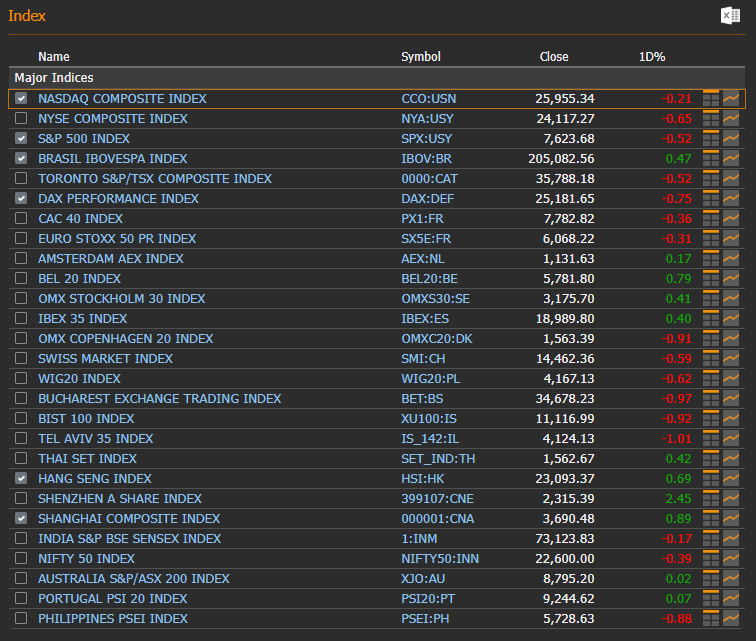
*The Dow quoted is the standard price-weighted index; it should not be confused with any equal-weighted Dow series.
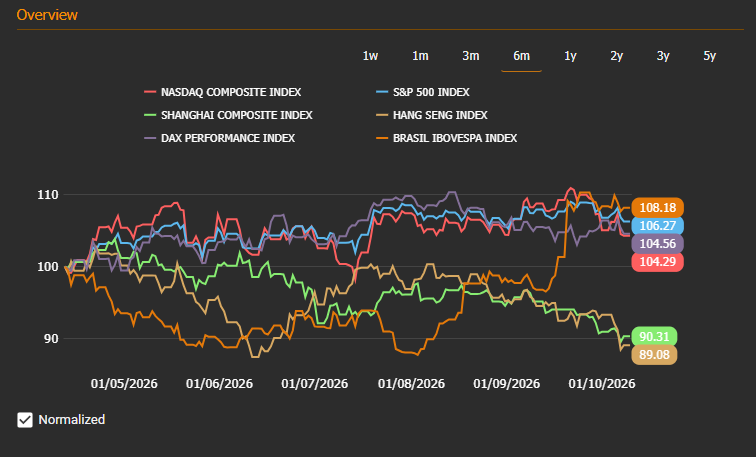
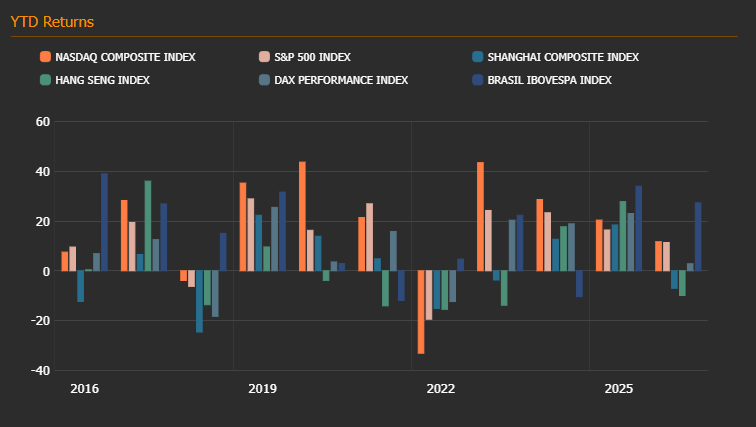
Source: EquityRT Markets Overview. Data as of 23/10/2026
Commodity Markets: Brent Surges Above $116 as Gold and Silver Retreat
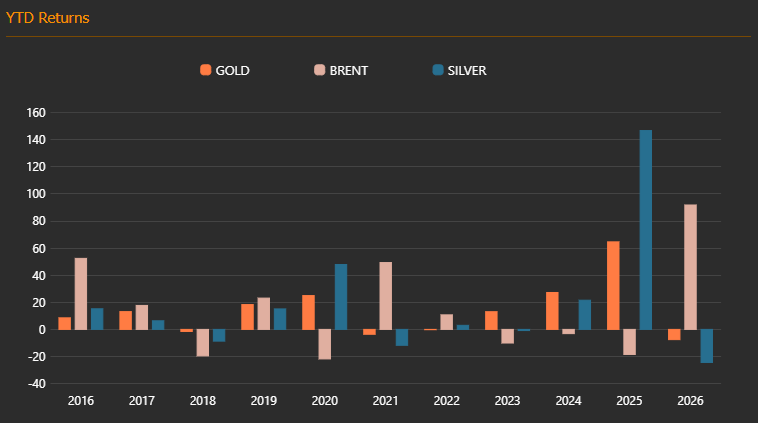
Oil prices climbed sharply during the week ending October 23 as attacks involving Yemen-based Houthis and Saudi Arabia intensified concerns over Middle East energy supply disruptions. Brent futures settled Friday at $116.72 per barrel, up 3.1% on the day and approximately 6% over the week, their highest close in nearly six months. WTI settled at $103.27, up 3.8% on Friday and 2.3% for the week.
Precious metals moved in the opposite direction. Spot gold fell below $4,000 an ounce intraday on Friday, reaching its lowest level since July, and was headed for a weekly decline of around 4%. Silver also weakened and was on course for a weekly loss. Rising oil prices reinforced concerns about inflation and the possibility that US interest rates will remain restrictive for longer.
The divergence highlights competing forces across commodities: supply risks have lifted oil prices, while elevated yields and expectations for further monetary tightening have reduced the appeal of non-yielding metals. The Fed decision and September PCE inflation report will be important near-term catalysts.
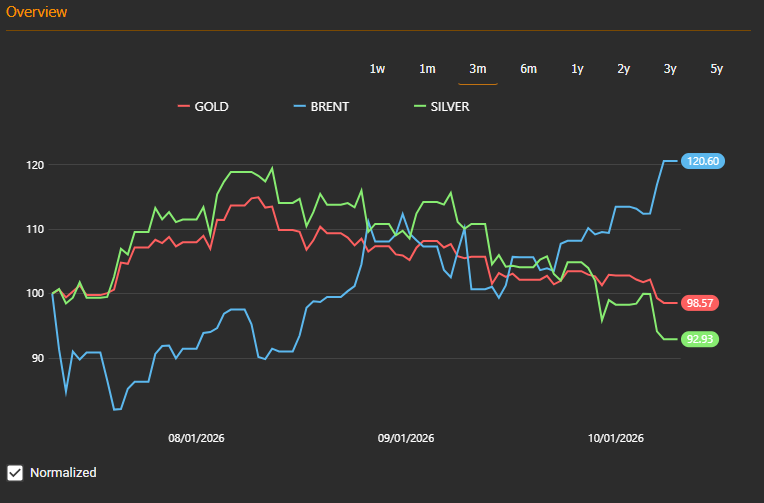
Source: EquityRT Commodity Overview. Data as of 23/10/2026
U.S. Yield Curve: Treasury Yields Ease, but the Curve Remains Positive
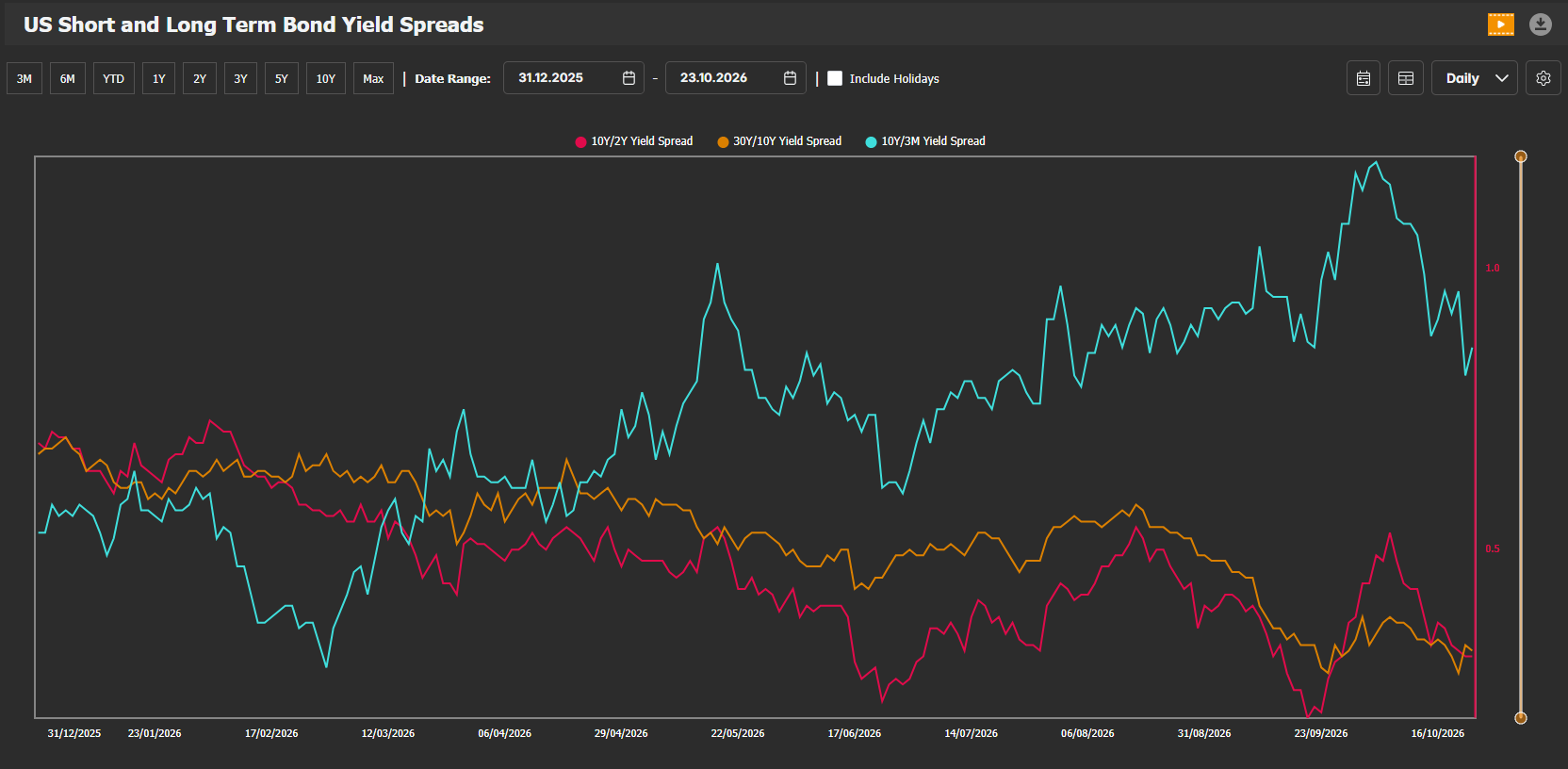
US Treasury yields ended the week of October 23 below their recent highs despite a modest rebound on Friday. The benchmark 10-year constant-maturity yield stood near 5.00%, compared with approximately 4.69% for the 2-year and 5.33% for the 30-year. Investors continued to weigh inflation risks from higher oil prices against expectations that the Federal Reserve would leave policy unchanged in October.
The 10Y-2Y spread was approximately 31 basis points, while the 30Y-10Y spread stood near 33 basis points. The 10Y-3M spread was around 78 basis points, leaving the curve positively sloped across the maturities shown. Compared with October 16, both 10-year and 30-year yields declined, while the 2-year yield also eased slightly.
The positive slope should not be attributed to any single cause: expected future policy rates, inflation and term premiums all influence longer-dated yields. Attention now turns to the Fed’s October 28 decision, third-quarter GDP and September PCE inflation for clues about the direction of yields and financing conditions.
Source: EquityRT ChartPro, Data as of 23/10/2026
Gold vs. DXY: Gold Slides as Oil-Driven Inflation Risks Support the Dollar
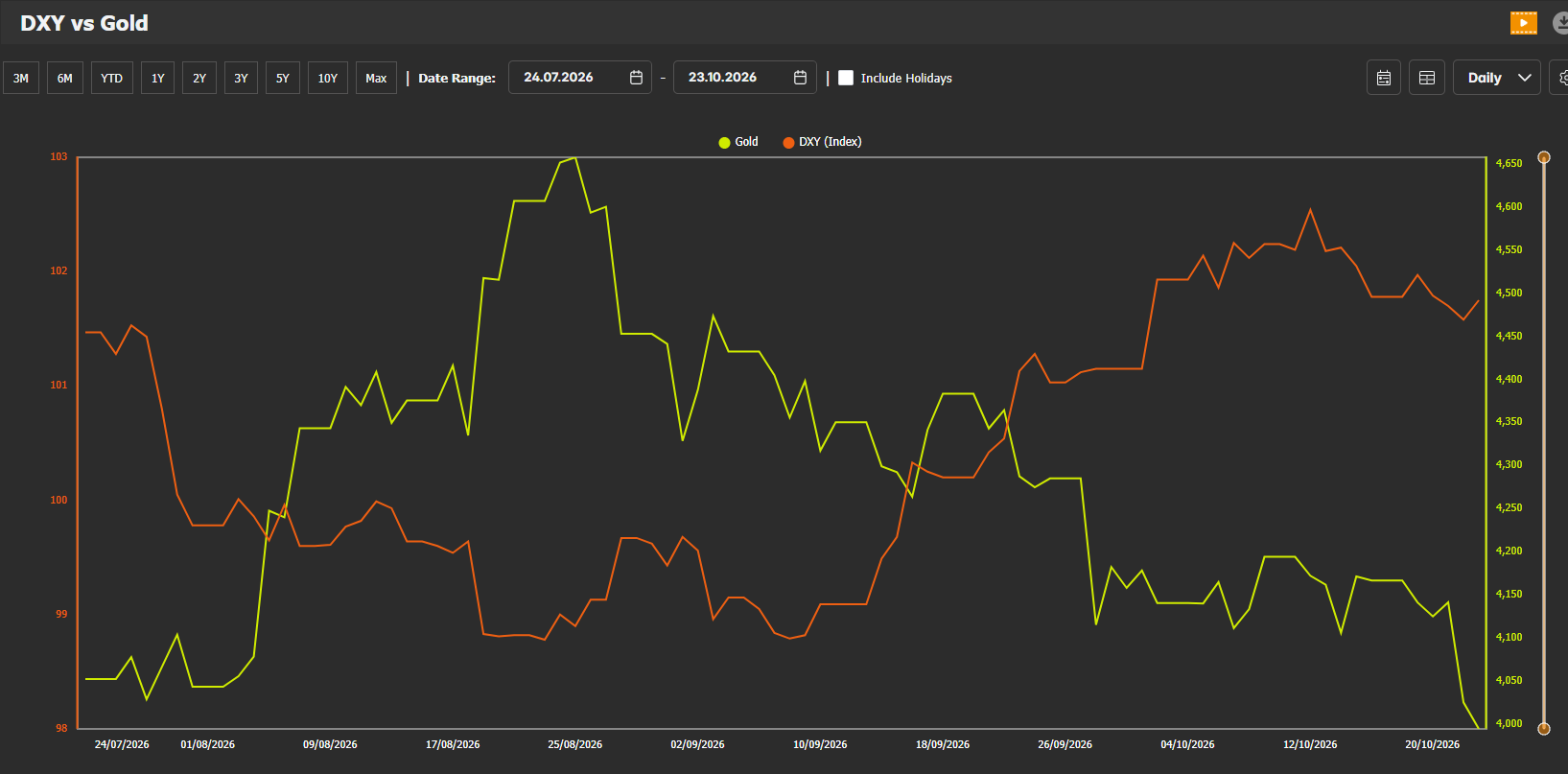
Gold came under heavy selling pressure during the week ending October 23, briefly slipping below $4,000 an ounce to its lowest level in three months. The decline coincided with renewed inflation concerns following a sharp rally in oil prices and expectations that US monetary policy could remain restrictive.
Gold was headed for a weekly decline of roughly 4%, its steepest since June, while silver and other precious metals also weakened. A firmer dollar and elevated real yields can increase the opportunity cost of holding bullion, although geopolitical uncertainty may provide intermittent safe-haven support. The Fed decision and September PCE inflation release will be important for the next move in both assets.
Source: EquityRT ChartPro, Data as of 23/10/2026
📈 Chart of the Week: U.S. Treasury Yields Climb as the Curve Flattens Ahead of the Fed
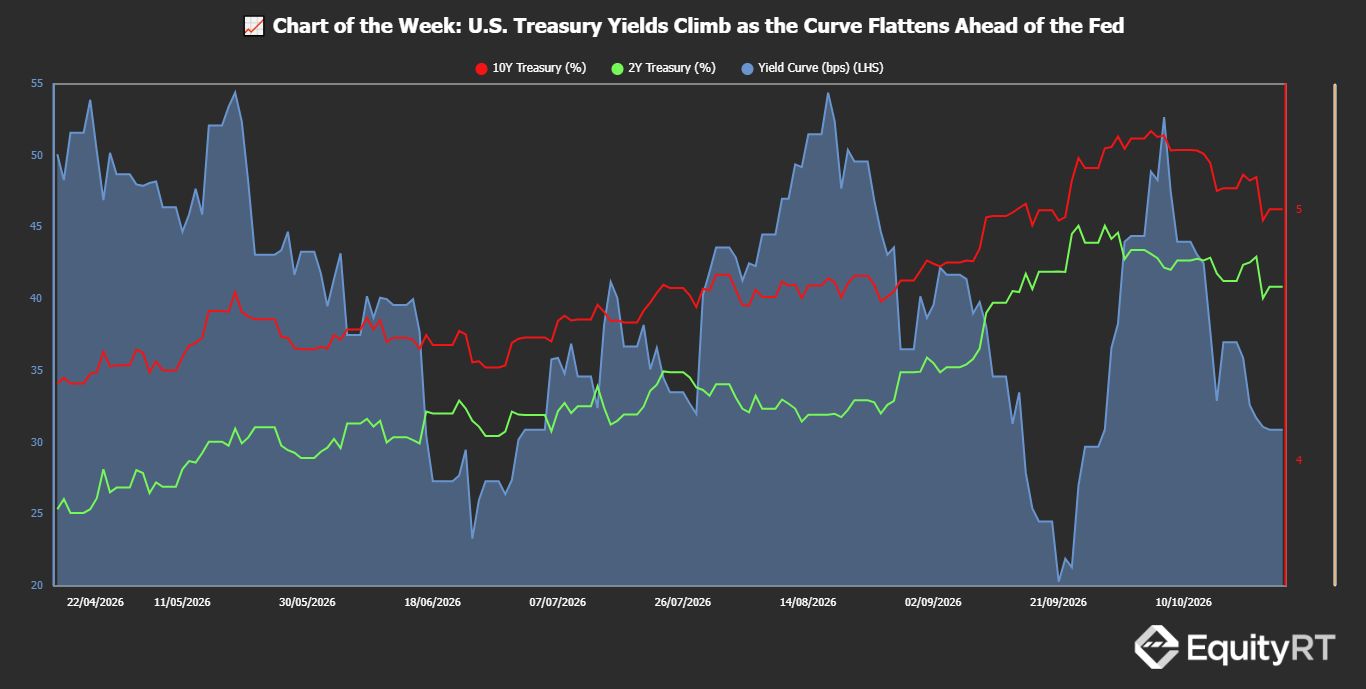
U.S. Treasury yields have risen considerably over the past six months, reflecting a repricing of interest rate expectations ahead of the Federal Reserve's October policy meeting. The 10-year Treasury yield has approached 5%, while the 2-year yield has climbed toward 4.7%, highlighting upward pressure across the yield curve.
Despite higher yields, the spread between 10-year and 2-year Treasuries has narrowed to approximately 30 basis points, down from around 50 basis points in late April.
The recent flattening suggests that shorter-term yields have risen more rapidly than longer-term yields, consistent with investors reassessing the pace and extent of future monetary easing.
With the Fed's policy decision approaching, attention turns to whether policymakers signal a prolonged period of restrictive interest rates.
Source: EquityRT | Data as of 23/10/2026