

Market Focus: US Midterms, Jobs Data and Central Bank Decisions Set the Tone
Global markets enter November 2-8 with US midterm elections, the October employment report and fresh business surveys in focus. The week follows a sharp technology-led equity selloff, stronger US growth and persistent inflation, leaving investors to reassess the outlook for monetary policy, corporate earnings and risk appetite.
The Federal Reserve held its policy rate at 3.75%-4.00% on October 28, with two policymakers favoring a quarter-point increase. US third-quarter GDP subsequently expanded at a 3.4% annualized rate, while September headline PCE inflation reached 3.6% year-on-year and core PCE stood at 3.1%. October payrolls, ISM surveys and wage data will help determine whether the combination of resilient growth and elevated inflation can persist.
The November 3 US congressional elections introduce a further source of uncertainty for fiscal and trade policy. In Europe, the Bank of England’s November 5 decision and the euro area’s October inflation estimate will test expectations for further tightening. Australia’s central bank also meets, while China’s private-sector PMI surveys will provide a timely reading on regional demand.
Middle East supply disruptions continue to support oil prices and complicate the inflation outlook. At the same time, concerns over the financing and profitability of AI infrastructure have weighed heavily on technology shares, creating a more cautious backdrop for global markets despite a recent retreat in US Treasury yields.
Earnings from Apple, AMD, Palantir, Qualcomm, Uber and other major companies will offer further evidence on technology demand, consumer spending and profit margins. Investors will also monitor oil-producer guidance and developments affecting energy supply routes.
U.S.: Midterm Elections, Payrolls and ISM Surveys Take Center Stage
The US midterm elections on Tuesday, November 3, will determine control of Congress and may influence expectations for fiscal policy, trade and regulation. Markets will assess the implications alongside the Federal Reserve’s October decision to hold its target range at 3.75%-4.00%, following a 10–2 vote that underscored policymakers’ differing views on inflation risks.
Friday’s October employment report will be the principal economic release. Payroll growth is expected to remain modest following September’s increase of 29,000, while the unemployment rate is forecast to remain around 4.2%. Average hourly earnings and revisions to earlier months will be important for assessing wage pressures and the underlying direction of labor demand.
The ISM Manufacturing PMI is scheduled for Monday, November 2, followed by the Services PMI on Wednesday, November 4. Investors will focus not only on activity and new orders but also on employment and prices-paid components, which may indicate whether higher energy and input costs are spreading through the economy. September JOLTS job openings, ADP employment figures, factory orders and trade data will provide additional context.
The latest official figures reinforce the policy dilemma. Third-quarter GDP accelerated to 3.4% annualized from 2.2% in Q2, while September PCE inflation increased 0.5% month-on-month and 3.6% year-on-year. Core PCE rose 0.3% on the month and 3.1% annually. With inflation still elevated, a weaker payroll reading could complicate rather than settle the debate over the Fed’s next move.
Corporate earnings remain a major driver of sentiment after disappointing guidance from several technology companies intensified concerns about the cost of AI investment. Reports from Apple, AMD, Palantir, Qualcomm, Uber, McDonald’s, Pfizer and others will be examined for evidence of sustainable revenue growth, pricing power and capital-spending discipline.
Canada will publish employment and trade figures, while Brazil and Mexico face monetary-policy decisions. Regional business surveys, inflation signals and trade data will help gauge how higher financing costs and energy prices are affecting activity across the hemisphere.
Europe: Bank of England Decision and Eurozone Inflation in Focus
The Bank of England announces its policy decision on Thursday, November 5, alongside an updated Monetary Policy Report. Its current Bank Rate is 3.75%. Market expectations lean toward a possible increase as higher energy costs threaten inflation, although the outlook remains uncertain; the vote split and revised projections will be as important as the decision itself.
The Euro Area’s preliminary October inflation estimate, scheduled for Wednesday, November 4, will provide an early indication of whether the energy shock is feeding into broader price pressures. September annual inflation stood at 3.8%. The European Central Bank held its deposit rate at 2.50% on October 29 and emphasized a meeting-by-meeting approach, with energy prices posing upside risks to inflation and downside risks to growth.
Economic activity has shown resilience despite tighter financial conditions. The euro area expanded by 0.4% quarter-on-quarter in the third quarter, compared with 0.6% in Q2, while annual growth reached 1.3%. The coming week’s manufacturing and services PMIs, retail sales and German industrial orders and output will help establish whether that momentum is being sustained.
Corporate results from Ryanair, Ferrari, Bayer, BMW, Rheinmetall and other European companies will add detail on consumer demand, industrial orders and margin pressures. Energy costs and fiscal conditions remain important cross-sector risks.
Asia-Pacific: Australia’s Rate Decision and China PMIs Lead the Agenda
The Reserve Bank of Australia meets on Tuesday, November 3, after lifting its cash-rate target to 4.60% in September. Another quarter-point increase is widely anticipated as elevated fuel prices and domestic capacity pressures complicate the inflation outlook. The accompanying policy assessment will be closely watched for the balance between persistent inflation and signs of slowing consumption.
China’s official manufacturing PMI fell to 49.3 in October from 50.1 in September, missing market expectations of 50.0 and signalling renewed contraction. The non-manufacturing PMI, covering services and construction, also declined to 49.7 from 50.2, slipping below the expansion threshold.
In Japan, September wage figures, final PMI readings and the minutes of the previous Bank of Japan meeting will help investors assess the prospects for further tightening. The central bank kept its policy rate at 1.25% in October while signaling that inflation risks continue to warrant attention.
Australia will also release building approvals, household spending and trade figures. Across the region, inflation data from South Korea, Indonesia, the Philippines, Thailand, Vietnam and Taiwan will offer insight into the pass-through of higher energy prices and the policy response.
Trade releases from South Korea and Southeast Asia, together with GDP figures from Hong Kong and Indonesia, will help assess the strength of external demand. Manufacturing PMI readings across the region will be especially relevant for economies exposed to the semiconductor cycle and global supply chains.
Corporate results from Nintendo and major Japanese and Indian companies will provide additional perspective on consumer demand and technology investment. Bank Negara Malaysia is also scheduled to announce its policy decision.
What Investors Should Watch
1. Will US Jobs Data Change the Fed’s Policy Outlook?
October payrolls, wage growth and the ISM employment components will test whether labor demand is cooling enough to offset the inflation risks highlighted by the Fed’s latest decision.
2. Will the Midterms Add to Market Volatility?
The November 3 congressional elections could alter expectations for fiscal policy, trade and regulation, with potential implications for the dollar, Treasury yields and sector performance.
3. Can Technology Earnings Rebuild Confidence in AI Spending?
Results from Apple, AMD, Palantir and other major companies will test whether AI-related capital expenditure is translating into sustainable earnings and cash flow.
4. Will Inflation Force More Central Banks to Tighten?
The Bank of England and Reserve Bank of Australia decisions, euro area inflation and energy-market developments will shape expectations for global policy rates.
Global Equities: AI Valuation Concerns Trigger a Sharp Technology Selloff
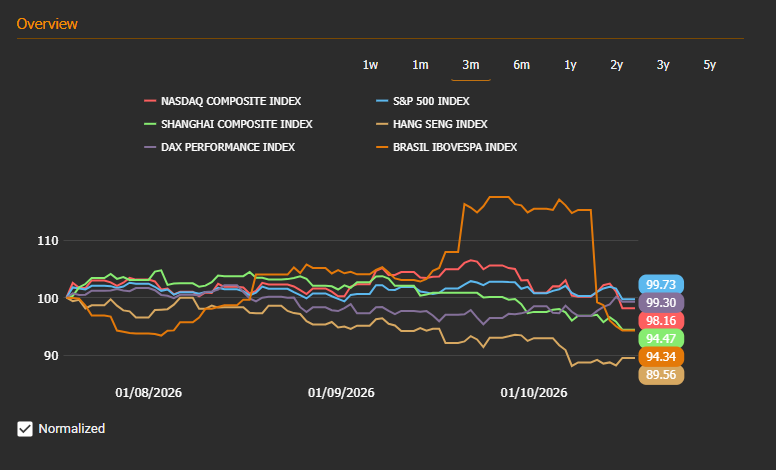
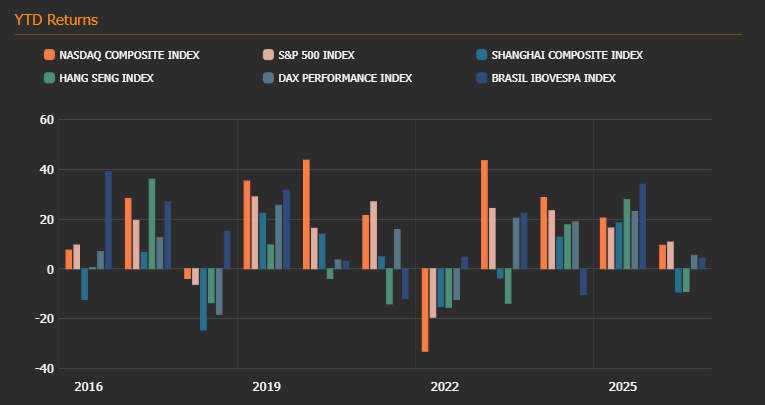
Global equity markets ended the week of October 30 on a cautious note as disappointing technology earnings and renewed doubts about the returns on AI infrastructure spending drove a sharp selloff in semiconductor and growth stocks. The pullback came despite stronger US third-quarter economic growth, highlighting the market’s increasing sensitivity to valuations, capital expenditure and forward guidance.
On Friday, the S&P 500 declined 1.8% to 7,580.07, the Nasdaq Composite lost 2.9% to around 25,437, and the Dow Jones Industrial Average fell 1.1% to 51,770.31.
For the week, the S&P 500 fell approximately 0.6%, the Dow lost 0.9% and the Nasdaq declined 2.0%. The divergence suggests that weakness was concentrated in large-cap technology rather than evenly distributed across the US market.
European equities also came under pressure on Friday, with the STOXX 600 slipping 0.36% to 646.75 as technology shares weakened, although the index still recorded its strongest month since June. Asian chip-related shares were volatile as investors weighed strong semiconductor demand against concerns over AI financing and profitability.
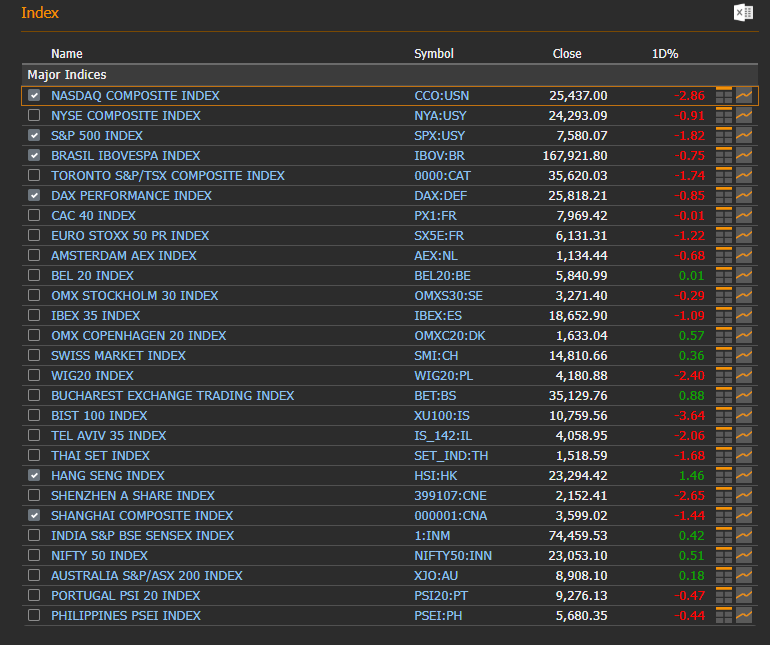
*The Dow quoted is the standard price-weighted index; it should not be confused with any equal-weighted Dow series.
Source: EquityRT Markets Overview. Data as of 30/10/2026
Commodity Markets: Oil Holds Above $110 as Precious Metals Sell Off
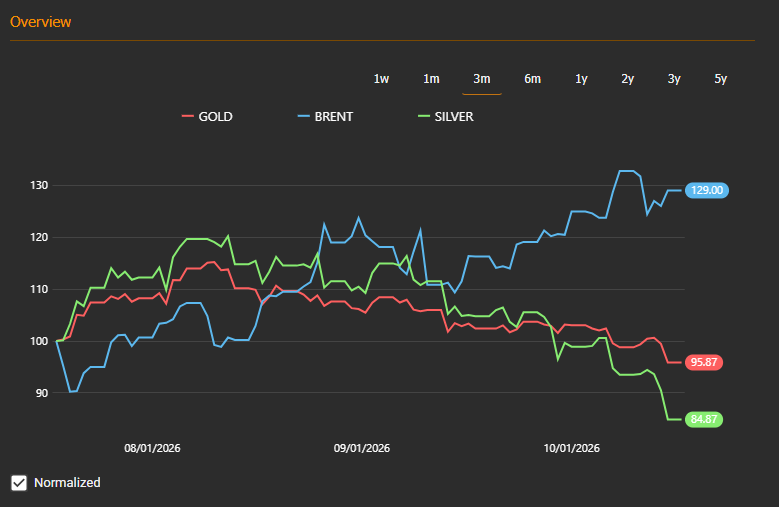
Energy markets remained supported by Middle East supply risks during the week ending October 30. Brent crude traded above $110 a barrel as attacks affecting shipping and regional infrastructure sustained concerns about disrupted exports. Renewed diplomatic efforts provided intermittent relief, but uncertainty over supply routes and the durability of any agreement kept a significant geopolitical risk premium in oil prices.
Precious metals moved sharply lower. Spot gold fell approximately 3.6% on Friday to around $3,875 an ounce, its weakest level in about a year, while silver dropped roughly 6.5% to near $49. Higher energy-driven inflation risks and expectations for restrictive interest rates weighed on non-yielding assets, while the technology selloff may also have prompted liquidity-related selling.
The contrasting performance of oil and gold underscores the competing forces facing investors. Supply constraints can sustain energy inflation, but a resilient US economy and expectations of tighter monetary policy raise the opportunity cost of holding bullion. Investors will watch geopolitical developments and the next US labor-market figures for signs of whether these pressures persist.
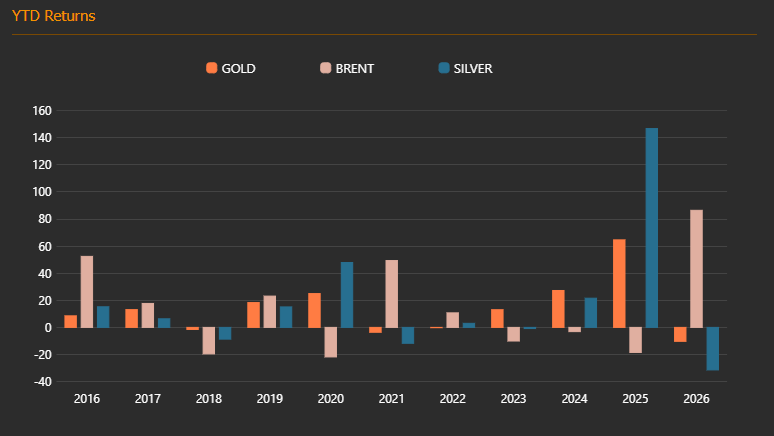
Source: EquityRT Commodity Overview. Data as of 30/10/2026
U.S. Yield Curve: Treasury Yields Retreat as Growth-Stock Selling Intensifies
US Treasury yields declined during the final week of October as investors moved toward government bonds amid a sharp technology-sector selloff. On October 30, the 2-year Treasury par yield stood at 4.56%, the 10-year at 4.94% and the 30-year at 5.31%. The benchmark 10-year yield was down from about 5.00% a week earlier, despite the Fed’s decision to keep rates unchanged and stronger-than-expected third-quarter GDP growth.
The curve remained positively sloped. The 10Y-2Y spread was approximately 34 basis points, the 30Y-10Y spread 37 basis points and the 10Y-3M spread about 85 basis points, based on October 30 par yields. The move in longer-term yields reflects shifting demand for duration and expectations for future growth and policy, rather than a simple reversal of inflation concerns.
The near-term outlook will depend on October payrolls, ISM price and employment components, and the Treasury’s quarterly refunding announcement. Strong labor-market data could revive expectations for further tightening, while weaker activity or additional equity volatility may sustain demand for longer-dated Treasuries.
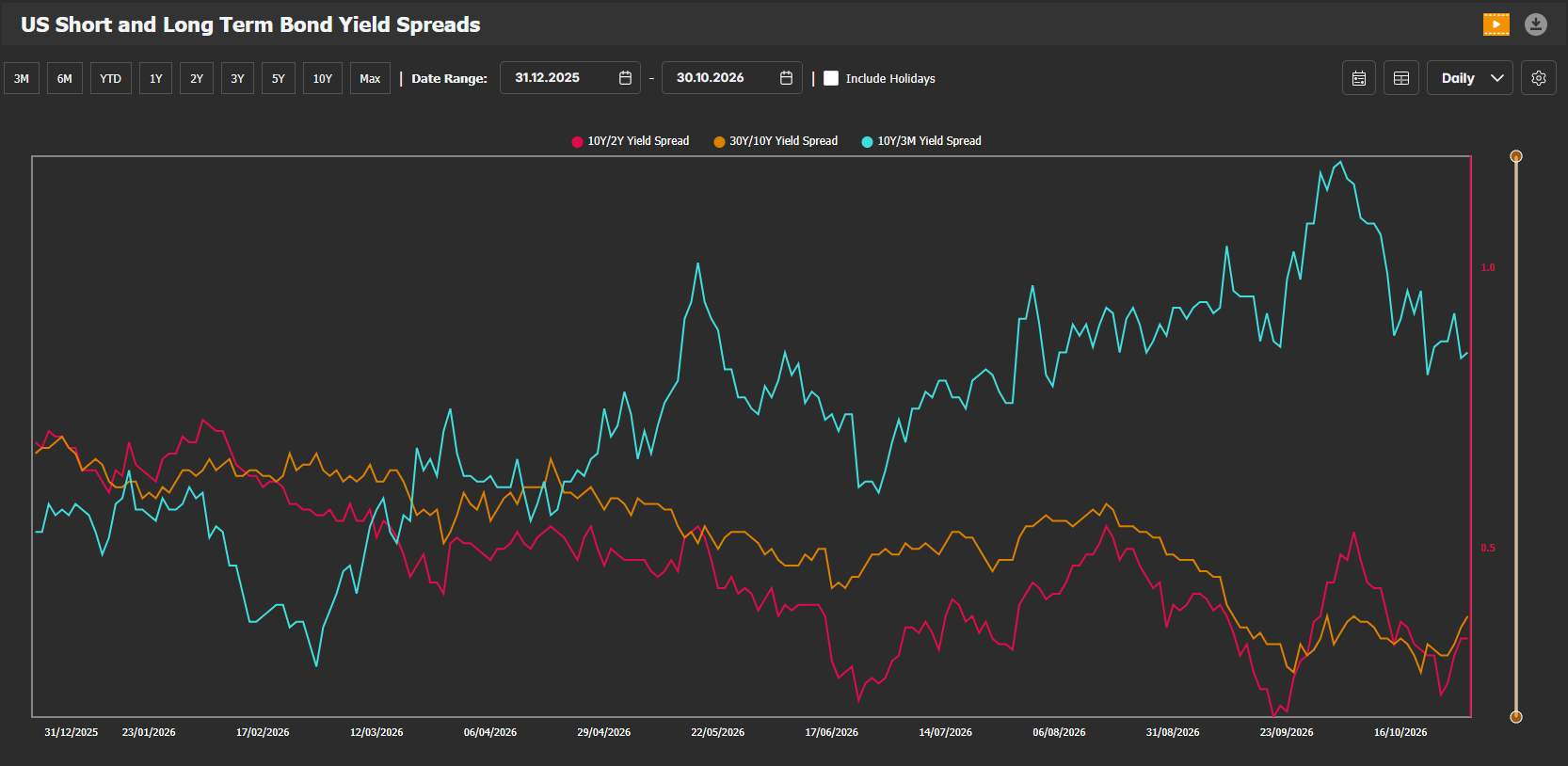
Source: EquityRT ChartPro, Data as of 30/10/2026
Gold vs. DXY: Bullion Plunges Despite a Softer Dollar
Gold’s relationship with the US dollar became less straightforward in the final week of October. Spot bullion fell to around $3,875 an ounce on Friday, a one-year low, even as the dollar was restrained by declining Treasury yields and a firmer yen. The dollar index traded near 102 late in the week and remained on course for a second consecutive monthly advance, but currency movements alone did not explain the scale of gold’s decline.
The sharp correction in precious metals coincided with heavy selling in technology shares, raising the possibility that investors liquidated bullion to meet cash needs or reduce risk. At the same time, higher oil prices and persistent inflation have kept expectations for restrictive monetary policy in focus. The next US employment report and shifts in real yields will be important for determining whether gold stabilizes or remains under pressure.
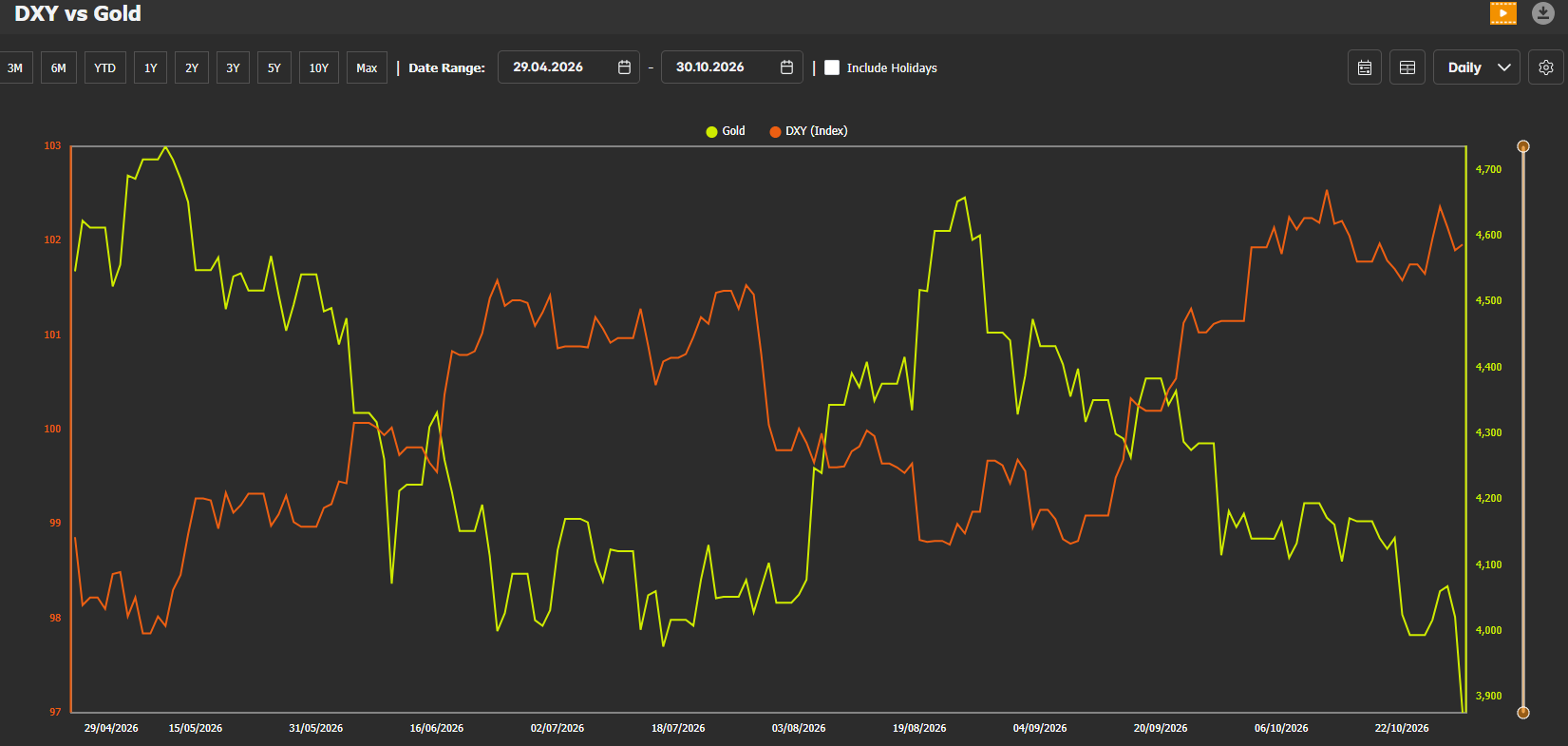
Source: EquityRT ChartPro, Data as of 30/10/2026
📈 Chart of the Week: Gold vs DXY: More Than a Dollar Story
Gold ended October under significant pressure, falling around 2.9% during the week and sliding 3.5% on Friday alone to approximately $3,881 per ounce, its lowest level in a year.
The US Dollar Index, remained firm near 101.9 but recorded only a marginal weekly increase.
The scale of gold’s decline therefore points to more than dollar strength. Higher-for-longer US interest-rate expectations, subdued Asian demand and forced selling amid the technology-led equity correction also weighed on the precious metal.
With gold now below the psychologically important $3,900 level, can weaker economic data or renewed safe-haven demand reverse the trend?
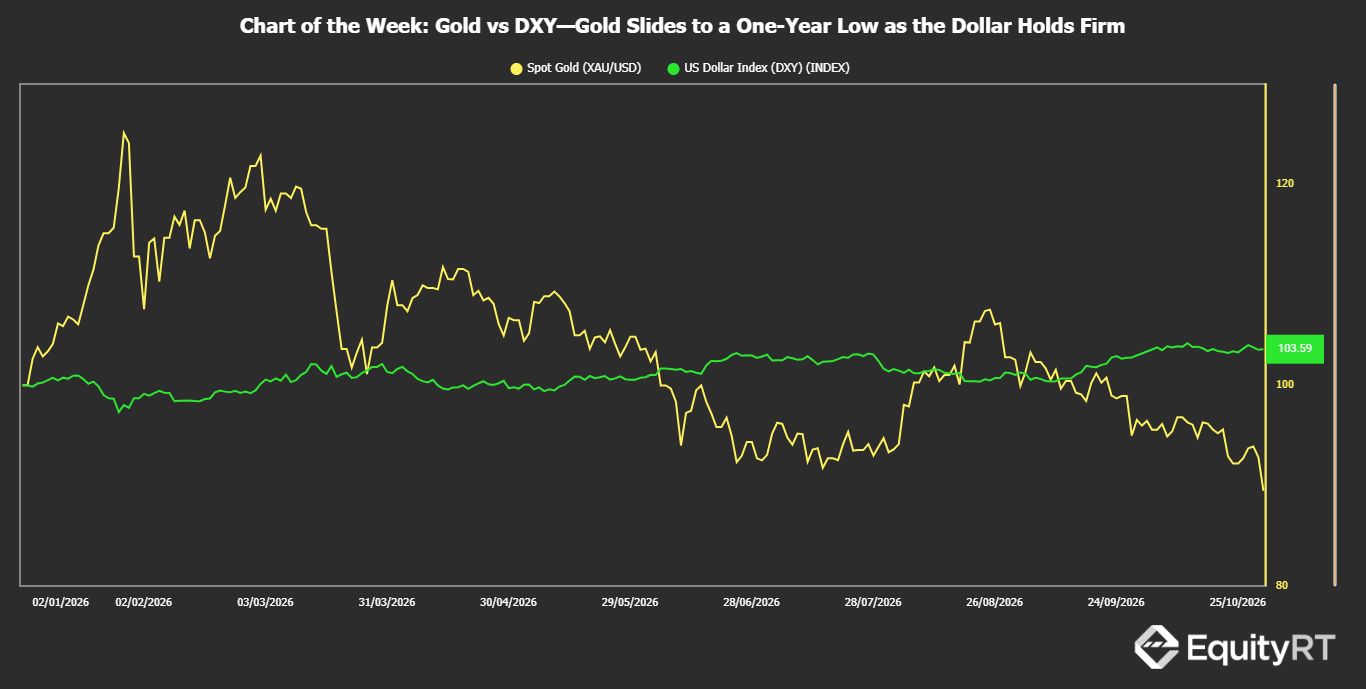
Source: EquityRT | Data as of 30/10/2026