

Market Focus: Fed Minutes Take Center Stage as Lower Oil Prices Shift Attention Back to Monetary Policy
Global markets enter the second week of July with geopolitical tensions easing and monetary policy returning to the forefront.
The sharp increase in tanker traffic through the Strait of Hormuz has helped restore confidence in global energy supplies, pushing oil prices sharply lower and reducing immediate inflation concerns. While geopolitical developments remain important, investors are increasingly turning their attention to whether lower energy prices will give central banks greater flexibility later this year.
Against this backdrop, the Federal Reserve’s June meeting minutes, China’s inflation data, Japan’s busy economic calendar, and fresh European economic releases will help shape expectations for growth, inflation, and interest rates during the second half of 2026.
US: Fed Minutes Under the Spotlight
The key event of the week will be the release of the Federal Reserve’s June meeting minutes.
While the Fed left interest rates unchanged, policymakers signaled growing concern that inflation could remain persistent, leaving markets debating whether another rate hike later this year remains possible. Investors will monitor the minutes for evidence of how divided officials were over the policy outlook and whether lower oil prices have begun to influence the inflation narrative.
Why it matters:
Although recent labor-market data suggest some moderation in hiring, inflation remains above target. Markets will therefore look for clues on whether the Fed believes lower energy prices are sufficient to ease inflation risks or whether restrictive policy may need to remain in place for longer.
Beyond the Fed minutes, investors will monitor ISM Services PMI, existing home sales, wholesale inventories, consumer credit, trade data, and inflation expectations for additional insight into the resilience of the US economy.
Europe: ECB Accounts and Industrial Activity
In Europe, attention will focus on the European Central Bank’s June meeting accounts, which should provide further insight into policymakers’ decision to resume rate hikes and their assessment of inflation risks.
Economic releases will also offer an updated picture of regional growth. Germany is expected to report improving industrial production and factory orders, while Italy’s industrial sector is also forecast to continue recovering. Trade figures from Germany and France will provide additional evidence on external demand, while Euro Area retail sales will indicate whether household spending is beginning to strengthen.
The key question remains whether improving industrial activity can offset still-fragile consumer demand and support a broader recovery across the region.
Asia-Pacific: Inflation and Manufacturing Take Focus
China will release June inflation data, providing another important test of domestic demand and pricing pressures following recent improvements in global trade conditions.
Japan’s packed calendar will include household spending, producer prices, current account data, and machine tool orders, offering a comprehensive assessment of the country’s economic momentum as policymakers continue to navigate persistent inflation and pressure on government bond yields.
Elsewhere, investors will monitor the Reserve Bank of New Zealand’s policy decision, inflation releases across the region, and Malaysia’s central bank meeting for further signals on the monetary policy outlook in Asia-Pacific.
What Investors Should Watch
Three themes are likely to drive markets this week:
1. Federal Reserve Communication: Will the June FOMC minutes reinforce expectations that US interest rates could remain higher for longer?
2. The Impact of Lower Oil Prices: Are easing energy costs beginning to reduce inflation pressures and improve the outlook for monetary policy?
3. Global Growth Signals: Can industrial production, services activity, and inflation data confirm that the global economy remains resilient despite restrictive financial conditions?
With oil prices retreating and geopolitical risks becoming less dominant, markets are once again being driven by the familiar macroeconomic forces of inflation, growth, and central bank policy. The coming week’s data and policy signals should provide investors with a clearer picture of whether lower energy prices are translating into improved inflation dynamics without undermining economic momentum.
Global Stock Markets Recap
Global equity markets finished the week on a strong footing as investors embraced a more constructive macro backdrop. Easing geopolitical tensions in the Middle East, Brent crude holding near pre-conflict levels, and softer-than-expected US labor market data improved risk appetite and reinforced expectations that the Federal Reserve may have less need to tighten monetary policy further.
US equities rallied across the board following the June employment report, which showed a much weaker-than-expected increase in nonfarm payrolls. The data prompted investors to scale back expectations for additional Fed rate hikes this year, supporting both equities and bond markets. The Dow Jones Industrial Average gained nearly 2% over the week, while the S&P 500 and Nasdaq Composite also posted solid advances as improving sentiment outweighed concerns surrounding the technology sector.
European equities outperformed most major regions. Germany’s DAX climbed to a fresh record high after the government reached agreement on a fiscal reform package aimed at supporting growth and providing tax relief for households. Lower-than-expected Eurozone inflation, helped by easing energy prices, further strengthened expectations that monetary conditions could gradually become more supportive.
Asian markets generally moved higher as easing oil prices and improving global risk sentiment supported regional equities. Lower energy costs provided additional relief for many of Asia’s major energy-importing economies, while stronger-than-expected economic data improved confidence in the regional growth outlook. Japan’s Nikkei, China’s Shanghai Composite, and Hong Kong’s Hang Seng all advanced, although South Korea’s KOSPI underperformed as sharp declines in major semiconductor stocks, including SK Hynix and Samsung Electronics, weighed on the broader market.

Source: EquityRT Markets Overview. Data as of 03/07/2026
Commodities
Brent crude remained under pressure, trading near USD 72 per barrel after surrendering most of the geopolitical premium built up earlier in the quarter. Improving tanker traffic through the Strait of Hormuz and continued progress in US-Iran peace negotiations reinforced expectations that global oil supplies would normalize, while OPEC+ discussions and ample near-term inventories further supported a softer price outlook.
Gold recovered from recent lows during the week after weaker-than-expected US labor market data dampened expectations of another near-term Federal Reserve rate hike. Lower Treasury yields and a softer policy outlook encouraged renewed buying interest, although bullion remains well below the record highs reached earlier this year as geopolitical risk premiums continue to fade.
Silver also rebounded but continued to underperform gold. While easing Fed tightening expectations provided support across precious metals, silver remained constrained by concerns over global manufacturing activity and softer industrial demand, particularly from China, limiting the pace of its recovery.

Source: EquityRT Commodity Overview. Data as of 03/07/2026
Yield Curve Watch: Soft Payrolls Reinforce the Case for a Gradual Policy Pivot
US Treasury yield spreads remained positively sloped through the holiday-shortened week, with the yield curve continuing to normalize as investors reassessed the outlook for Federal Reserve policy following weaker-than-expected June employment data.
The June payroll report pointed to a meaningful cooling in labor market conditions, prompting markets to scale back expectations of another near-term Fed rate hike. Treasury yields declined following the release, particularly at the short end of the curve, as investors shifted toward pricing a more gradual policy path.
The 10Y-3M spread widened modestly to around 0.73%, reversing part of its recent decline. Although well below its May peak above 1%, the curve remains comfortably positive, suggesting recession concerns have eased while markets increasingly anticipate lower policy rates over the medium term.
The 30Y-10Y spread held close to 0.50%, indicating that investors continue to demand a meaningful premium for holding longer-dated Treasuries. Persistent fiscal deficits, elevated Treasury issuance, and uncertainty surrounding long-run inflation continue to support higher long-end yields even as near-term inflation pressures moderate.
Meanwhile, the 10Y-2Y spread remained near 0.31%, close to its narrowest level of the year. The continued flattening reflects a market that expects inflation to cool gradually and economic growth to moderate, while viewing the Federal Reserve as increasingly likely to pause rather than resume aggressive tightening.
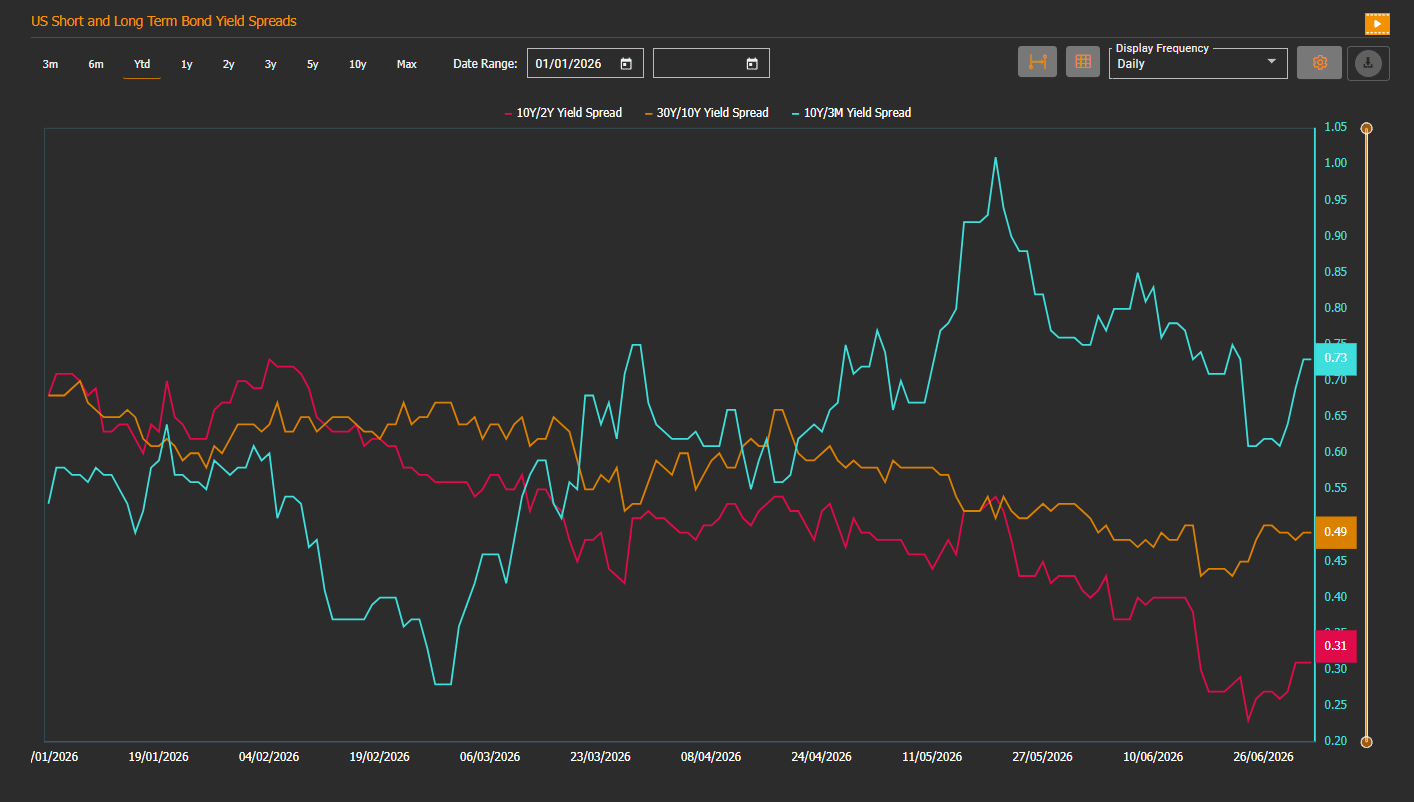
Source: EquityRT ChartPro, Data as of 03/07/2026
Gold vs USD: Gold Stabilizes as Fed Expectations Shift
The traditionally inverse relationship between gold and the US dollar remained evident through early July, although recent price action suggests that the relationship has become more nuanced.
The US Dollar Index (DXY) continued to strengthen, climbing above 100.8 as investors remained confident in the resilience of the US economy. However, after several weeks of heavy selling, gold stabilized and posted a modest recovery, indicating that easing expectations of further Federal Reserve tightening have begun to offset some of the pressure from a stronger dollar.
Earlier in the year, gold was driven primarily by geopolitical tensions and strong safe-haven demand. More recently, attention has shifted toward monetary policy and macroeconomic data. The weaker-than-expected June US employment report reduced expectations of another near-term Fed rate hike, leading Treasury yields to decline and providing renewed support for bullion despite continued dollar strength.
Going forward, the interaction between the dollar, Treasury yields, and incoming inflation data is likely to remain the dominant theme. A sustained moderation in inflation or clearer signals of future Fed easing could provide further support for gold, even if the US dollar remains relatively strong.

Source: EquityRT ChartPro. Data as of 03/07/2026
📈 Chart of the Week: The Last Mile of Inflation
After making significant progress in bringing inflation down from post-pandemic highs, the Federal Reserve now faces a more difficult challenge: the final stretch toward its 2% target.
Core PCE inflation declined steadily through much of 2024 and early 2025, allowing the Fed to begin easing policy from its peak restrictive stance. However, recent data indicate that underlying price pressures have become more persistent, with Core PCE moving higher again despite lower energy prices and easing geopolitical tensions.
At the same time, the Federal Funds Rate remains well above the Fed’s long-run inflation objective, underscoring that monetary policy is still restrictive. This combination suggests policymakers are likely to proceed cautiously, seeking clearer evidence that inflation is moving sustainably back toward target before considering more aggressive rate cuts.
The challenge now is whether the Fed can complete the “last mile” without unnecessarily weakening economic growth.

Data as of 05/07/2026
EquityRT ChartPro