
Market Focus: Earnings Season, Central Banks and Growth in Focus
Global markets head into the third week of July with attention shifting from geopolitical developments back to corporate earnings, central bank decisions, and the strength of the global economy.
Although tensions in the Middle East continue to influence market sentiment, the normalization of oil flows through the Strait of Hormuz has helped stabilize energy prices and ease immediate inflation concerns. As a result, investors are increasingly focusing on whether resilient economic activity and corporate earnings can continue supporting risk assets while central banks remain cautious.
Against this backdrop, a busy earnings calendar, the European Central Bank’s policy decision, July PMI surveys, and key inflation and labor-market data will provide fresh clues on the outlook for growth, inflation, and interest rates.
US: Earnings Take Center Stage
With Federal Reserve officials entering their pre-meeting blackout period ahead of the July 28–29 FOMC meeting, the focus shifts to second-quarter earnings and a lighter batch of economic releases.
Several market heavyweights, including Alphabet, Tesla, Intel, IBM, Texas Instruments, GE Vernova, General Motors, Exxon Mobil, and American Express, are due to report results, offering important insight into corporate profitability, AI investment, consumer demand, and industrial activity.
Economic releases will include the S&P Global Flash PMIs, June new home sales, the Chicago Fed National Activity Index, the Conference Board’s Leading Economic Index, and regional Fed manufacturing surveys.
Why it matters
Markets are looking for confirmation that the US economy remains resilient despite restrictive monetary policy. Strong earnings and stable business activity could reinforce confidence in the growth outlook, while weaker corporate guidance may strengthen expectations that the Fed will eventually begin easing policy.
Europe: ECB Decision and PMI Surveys
The European Central Bank will take center stage, with policymakers widely expected to leave interest rates unchanged after last month’s 25-basis-point increase.
Investors will focus on President Lagarde’s guidance for the remainder of the year and whether the ECB continues to signal another rate increase later in 2026.
Flash PMI surveys from the Euro Area and its largest economies will provide one of the earliest readings of July business activity, while Germany’s ZEW Economic Sentiment Index and GfK Consumer Confidence will offer additional insight into improving confidence across the region.
In the UK, attention will turn to inflation, labor-market data, retail sales, and July PMI surveys as investors assess whether easing price pressures could give the Bank of England greater policy flexibility.
Asia-Pacific: Inflation and Growth Signals
China is expected to keep both its one-year and five-year Loan Prime Rates unchanged, leaving investors focused on policy stability rather than additional stimulus.
Japan’s June trade balance and national CPI will provide fresh insight into export momentum and inflation trends, while preliminary PMI surveys will offer an early assessment of business activity.
Australia will release labor-market data, South Korea will publish second-quarter GDP, and Bank Indonesia will announce its latest monetary policy decision as policymakers continue balancing inflation risks with currency stability.
What Investors Should Watch
Three themes are likely to drive markets this week:
1. Corporate Earnings
Can strong results from major technology, industrial, and energy companies justify elevated equity valuations and sustain investor optimism around AI?
2. Central Bank Guidance
Will the ECB maintain a hawkish tone despite easing energy prices, and what signals emerge ahead of the Fed’s July meeting?
3. Global Growth Momentum
Will July PMI surveys and key economic releases confirm that global activity remains resilient despite restrictive financial conditions and lingering geopolitical uncertainty?
Global Stock Markets Recap
Global equity markets ended the week lower as investors reassessed lofty technology valuations while renewed geopolitical tensions in the Middle East dampened risk appetite. The sell-off was driven primarily by semiconductor stocks, with concerns mounting that the AI-driven rally may have become overstretched despite another solid earnings season ahead. Renewed US-Iran tensions also pushed oil prices higher, adding to market uncertainty.
US equities posted broad-based losses. The Nasdaq Composite underperformed, falling 2.9% for the week, as semiconductor and AI-related shares extended their correction. The S&P 500 declined 1.6%, marking its first weekly loss in three weeks.
European equities also retreated. The DAX and the broader STOXX Europe 600 came under pressure as weakness in global technology shares outweighed generally resilient economic data.
Asian markets experienced the sharpest declines. Semiconductor-heavy markets led the sell-off despite strong earnings from Taiwan’s TSMC, as investors questioned whether AI-related capital spending can continue to justify elevated valuations.
Chinese equities also weakened amid ongoing concerns over domestic growth, while Australian shares proved relatively resilient thanks to gains in energy and defensive sectors.

Source: EquityRT Markets Overview. Data as of 17/07/2026
Commodity Markets: Oil Rises on Geopolitical Risks While Precious Metals Weaken
Commodity markets delivered mixed performance during the week. Brent crude oil rebounded as renewed tensions between the US and Iran revived concerns over potential supply disruptions in the Middle East, reversing part of the sharp declines seen after the Strait of Hormuz reopened.
In contrast, gold extended its recent correction despite heightened geopolitical uncertainty. A stronger US dollar and rising expectations that the Federal Reserve could keep interest rates higher for longer reduced the appeal of non-yielding assets, outweighing traditional safe-haven demand. Gold recorded its largest weekly decline since early June.
Silver underperformed both gold and oil, pressured by the combination of higher real yields and weaker sentiment toward industrial metals as investors reassessed the outlook for global manufacturing and technology demand.

Source: EquityRT Commodity Overview. Data as of 17/07/2026
Yield Curve Watch: Higher-for-Longer Expectations Keep the Curve Positively Sloped
US Treasury yield spreads remained positively sloped through mid-July, with the yield curve continuing to normalize as investors reassessed the outlook for Federal Reserve policy amid resilient economic data and renewed inflation concerns.
The recent rise in oil prices following renewed tensions in the Middle East has reinforced expectations that inflation could prove more persistent, leading markets to scale back expectations for near-term policy easing. While the Federal Reserve is still expected to remain on hold at its July meeting, investors increasingly believe interest rates may need to stay elevated for longer.
The 10Y-3M spread remained the steepest part of the curve at around 0.75%, suggesting recession concerns have eased while markets continue to anticipate lower policy rates over the medium term rather than an imminent easing cycle.
The 30Y-10Y spread edged higher to approximately 0.52%, reflecting a continued term premium as investors demand additional compensation for holding longer-dated Treasuries. Persistent fiscal deficits, elevated Treasury issuance, and uncertainty surrounding the long-run inflation outlook continue to support long-end yields.
The 10Y-2Y spread widened to around 0.37%, recovering from its June lows. Although the curve remains positively sloped, the relatively modest spread suggests investors still expect economic growth to moderate gradually, while viewing the Federal Reserve as likely to maintain a cautious, data-dependent approach before considering rate cuts.
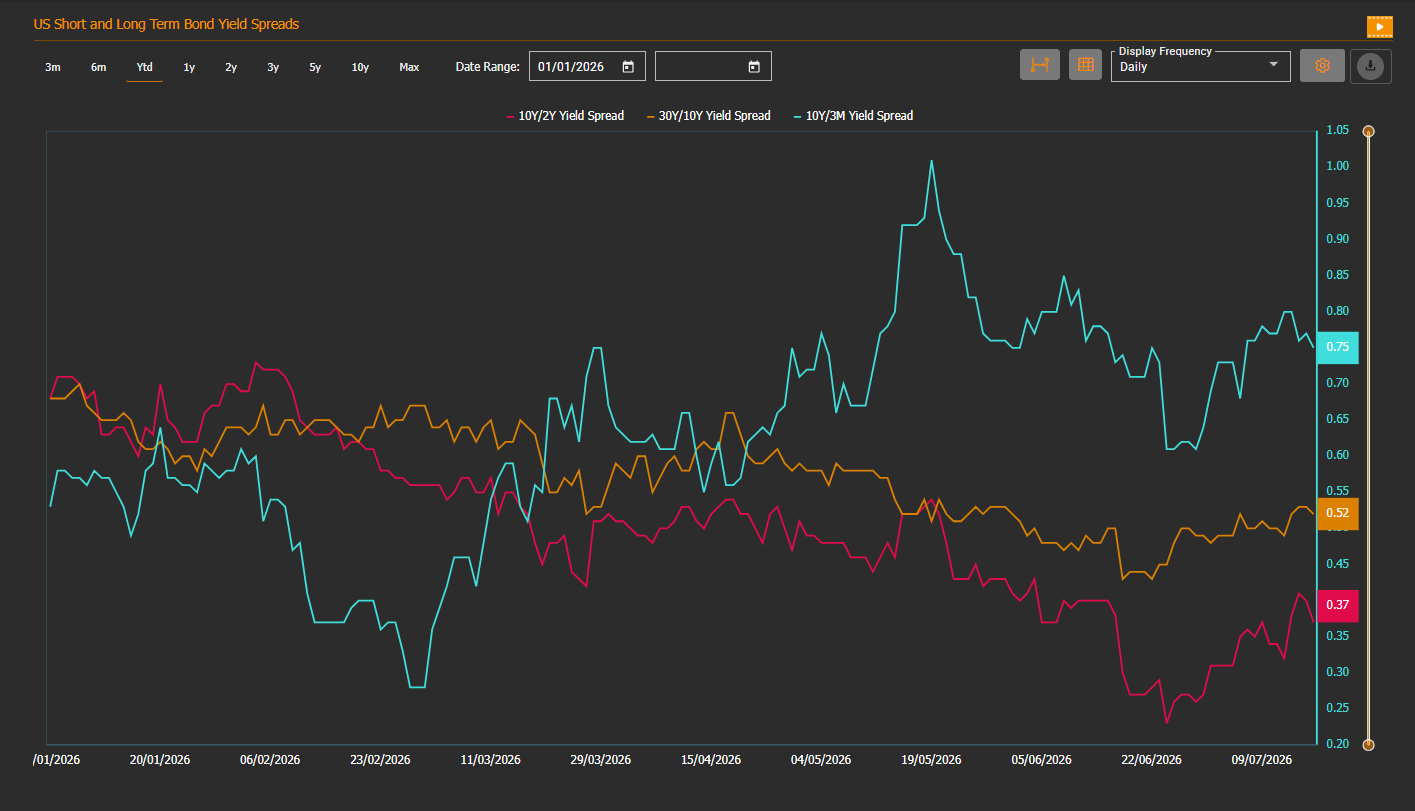
Source: EquityRT ChartPro, Data as of 17/07/2026
Gold vs DXY: Dollar Strength Continues to Weigh on Gold
The inverse relationship between gold and the US dollar remained the dominant theme through mid-July. The US Dollar Index (DXY) strengthened to around 100.8, supported by resilient US economic data and expectations that the Federal Reserve will maintain a restrictive policy stance for longer. At the same time, gold extended its recent correction, falling to its lowest level since early July despite a modest rebound at the end of the week.
While geopolitical tensions between the US and Iran would typically boost demand for safe-haven assets, rising oil prices have instead reinforced concerns that higher energy costs could slow the disinflation process. This has strengthened expectations that the Fed may keep interest rates elevated for longer, increasing the opportunity cost of holding non-yielding assets such as gold. A firmer US dollar has added further pressure by making bullion more expensive for international buyers.

Source: EquityRT ChartPro. Data as of 17/07/2026
LinkedIN (To be posted on Wednesday)
📈 Chart of the Week: Why Are Both the Dollar and US Stocks Rising?
The US dollar and the S&P 500 have moved higher together for much of 2026, challenging the traditional relationship in which a stronger dollar often weighs on equity markets.
The US Dollar Index (DXY) has climbed above 100.7, supported by resilient economic data and expectations that the Federal Reserve will keep interest rates elevated for longer. At the same time, the S&P 500 has continued to trade near record highs, underpinned by solid corporate earnings, optimism surrounding AI investment, and continued inflows into US assets.
This unusual combination reflects continued confidence in the relative strength of the US economy. Rather than seeking safety alone, global investors have favored US financial assets because of their combination of economic resilience, attractive yields, and technology leadership.
The challenge now is whether the Fed can complete the “last mile” without unnecessarily weakening economic growth.
Data as of 17/07/2026
EquityRT ChartPro
Data in the chart may be subject to revision.